


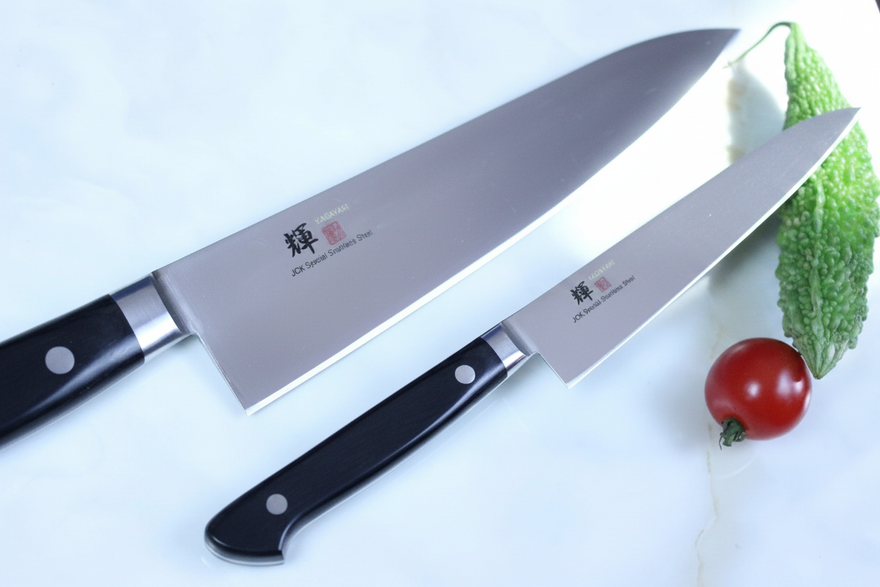
A good starter knife set does not need a long block full of rarely used blades. For most home cooks, a thoughtful three-knife combination is more practical, easier to maintain, and far better for learning proper technique. In Japanese kitchens, that usually means choosing a primary all-purpose knife, a compact utility knife, and one task-specific knife that matches how you actually cook. If you are still deciding between profiles, our gyuto knife guide is a useful place to start. From Japanese Chefs Knife in Seki City, Gifu Prefecture, this advice is shaped by the practical knowledge that comes from working close to Japan’s knife industry and from Koki Iwahara’s more than decades in the Japanese knife export trade.
What a Starter Knife Set Should Include
The best beginner knife set is built around function, not quantity. In most kitchens, three knives cover nearly everything: a larger main knife for board work, a smaller knife for in-hand detail work, and a third knife that supports your dominant prep style.
For Japanese knives, that main knife is often a gyuto, the Japanese chef’s knife. It handles proteins, vegetables, herbs, and most daily prep. If your cooking leans more toward compact prep and home-style versatility, a santoku can fill that role instead. Our santoku knife guide explains why that profile appeals to so many beginners.
The second knife is usually a petty. This is the knife you reach for when peeling fruit, trimming silver skin, halving shallots in your hand, or doing small, controlled work where a full-size gyuto feels oversized.
The third knife depends on your habits. If you prep a lot of vegetables, a nakiri often makes more sense than adding another general-purpose blade. If you mostly want a very simple first Japanese knife set, the classic three-piece structure is gyuto, santoku, and petty, especially for households where more than one person cooks.
The Essential 3-Knife Starter Guide

1. Main knife: Gyuto or Santoku
Your first decision is the lead knife. A gyuto usually offers the broadest range. Its longer edge and pointed tip make it more adaptable for slicing proteins, trimming, mincing, and push-cutting vegetables. A santoku is shorter, taller, and often feels more approachable for home cooks working on smaller boards.
As a rule, choose a gyuto if you want one knife that can grow with your skills. Choose a santoku if you prefer a slightly shorter blade and a simpler, compact feel.
2. Support knife: Petty
A petty belongs in nearly every first Japanese knife set. It handles the work a larger knife should not do: hulling strawberries, trimming mushrooms, segmenting citrus, topping beans, and cleaning up small ingredients. In practice, this is often the knife that makes a set feel complete.
For most beginners, 120mm to 150mm is the most practical range. Longer petty knives can overlap too much with a santoku or shorter gyuto, while very short paring knives are more specialized.
3. The flexible third knife
This is where many buyers overcomplicate things — and also where the most personal decision happens. The right third knife depends almost entirely on how you actually cook, not on what looks impressive in a set.
For most beginners, the most practical third options are:
- Santoku — if your main knife is a gyuto and you want a shorter, more compact blade for everyday home prep
- Gyuto — if your main knife is a santoku and you want more reach for proteins and larger ingredients
- Nakiri — if vegetables dominate your prep and you want a dedicated flat-edge blade for clean, straight-down cuts
But cooking habits vary, and the third knife can go in a different direction entirely depending on what you do most:
- Sujihiki (slicing knife) — if you frequently slice roasts, fish fillets, or large proteins and want a long, clean draw cut
- Honesuki (boning knife) — if you regularly break down poultry or trim around bone and need a stiffer, more precise blade for that work
- Petty (150mm) — if you already have a shorter petty and want a longer utility knife that bridges the gap between your main knife and a small paring blade
If you are comparing complete combinations, our overview of best japanese knife sets can help you think through different mixes.
A Verified Beginner-Friendly Japanese 3-Knife Set
If you want a ready-made answer, one of the clearest beginner options in the current catalog is the JCK Special Set “First Japanese Knife Set Type II” JCK Original Kagayaki Basic Series (Petty 125/150mm, Santoku 180mm, Gyuto 210/240mm) at $237 to $279. This set is built around VG-1 stainless steel at HRC 60 with a 70/30 double-bevel edge and black Pakka wood handles with stainless bolsters.
That specification matters. VG-1 stainless is a sensible starting point because it balances sharpness, corrosion resistance, and manageable maintenance. HRC 60 is hard enough to give you the cleaner, more precise feel people expect from Japanese knives, but not so hard that the set becomes unforgiving for a novice. A 70/30 edge also reflects Japanese cutting style while remaining practical for general kitchen work.
The format is strong for a first japanese knife set because it gives you a true working trio rather than filler pieces. You can choose between petty and gyuto sizes to better suit your space and cooking volume. For many home cooks, that flexibility makes it a better starter knife set than a fixed bundle.
Another valid path is to build your own three-knife set from entry-friendly stainless lines. For example:
- JCK Original Kagayaki Basic Series Gyuto — $115(180mm) to $185 (270mm)
- JCK Original Kagayaki Basic Series KG-3 Santoku 180mm — $120
- JCK Original Kagayaki Basic Series Petty — $80 (125mm) or $85 (150mm)
These use the same VG-1 stainless platform and let you tailor sizes more precisely to your board space and cooking habits.
If you prefer a softer, more forgiving stainless feel, the Misono Molybdenum Steel Series offers an AUS-8 alternative at HRC 57. The JCK Special Set “First Japanese Knife Set Type I” Misono Molybdenum Steel Series bundles a petty, santoku, and gyuto for a convenient ready-made option. You can also build your own Misono set from individual knives:
- Misono Molybdenum Steel Series Gyuto (180mm to 360mm, 8 sizes)
- Misono Molybdenum Steel Series Santoku (140mm to 180mm, 3 sizes)
- Misono Molybdenum Steel Series Petty (120mm to 150mm, 3 sizes)
AUS-8 is easy to resharpen and very approachable for beginners who want a gentle introduction to Japanese knife geometry without committing to a harder steel right away.
For readers who want to keep costs in check while still buying within authentic Japanese production, it is also worth reviewing some budget japanese knives before committing to a more premium steel or more specialized shape.
When you are ready to compare real options, Japanese Chefs Knife is a strong place to continue because the range includes practical beginner-friendly stainless lines, more advanced carbon steel choices, and specialist guidance rooted in Japan’s knife trade. From Seki City, with worldwide shipping and decades of export experience behind the store, you can explore an entry set with confidence rather than guessing from generic marketplace listings.
How to Choose the Right First Japanese Knife Set
There is no single best starter knife set for every cook. The right choice depends on your prep style, maintenance tolerance, and how quickly you want to grow into more specialized knives.
1. Start with stainless unless you specifically want carbon steel
For most beginners, stainless is the better first step. Steels like VG-1, VG-10, and AUS-8 are easier to live with day to day because they are less reactive and more forgiving if you do not wipe the blade immediately after every cut. Carbon steels such as white steel (Shirogami) and blue steel (Aogami) can be outstanding, but they ask more from the owner.
If you are not yet sure about wiping, drying, oiling, and stone sharpening habits, stainless usually makes the better beginner knife set foundation.
2. Choose blade lengths that match your board and kitchen space
A 210mm gyuto is often the safest all-around starting point. It is long enough to feel like a real chef’s knife, but not so large that it becomes awkward on a home cutting board. For santoku, 170mm to 180mm is the common sweet spot. For petty knives, 125mm to 150mm usually covers the most useful detail work.
Very long blades are excellent when technique and board space support them. For a first set, moderate lengths usually lead to faster confidence.
3. Do not overbuy specialized shapes too early
A lot of first-time buyers are tempted by deba, yanagiba, or kiritsuke because they represent classic Japanese knife culture. Those knives are real tools with specific jobs, not status pieces. A deba is thick, heavy, and purpose-built for fish breakdown. A yanagiba is for long, single-draw slicing. A traditional kiritsuke can demand very good technique depending on grind and geometry.
Unless you already know why you need them, they usually do not belong in a beginner knife set.
4. Pay attention to handle style and balance
Western handles, often in Pakka wood with a bolster, generally feel familiar to cooks coming from European-style knives. Wa handles, usually lighter and more forward-balanced, can make the blade feel more agile. Neither is automatically better. It is a matter of comfort, grip preference, and what kind of balance helps your cutting style.
In a starter knife set, consistency can be helpful. Three knives with similar handle feel often make the transition easier.
5. Think about sharpening from day one
Japanese knives reward whetstone maintenance. Even a good starter knife set should be seen as part of a system, not just three blades in isolation. If you are buying your first Japanese set, it is wise to also think about a practical maintenance path. A combination stone like the JCK Special Combination Whetstone #1000/#4000 Grit ($65) is a reasonable companion for many beginners who want one stone for edge maintenance and light refinement.
Sharpening also affects how a set performs over time. A modestly priced knife that is properly maintained will usually serve you better than a more expensive knife that is neglected.
Japanese Vegetable and Ingredient Cutting Techniques for Beginners
Here’s the thing: a starter knife set becomes much more valuable when you connect each knife to a few foundational Japanese cutting patterns. You do not need to memorize a long vocabulary list, but learning the basic shapes helps you prep more consistently, and it also helps you understand why profiles like gyuto, santoku, nakiri, and petty exist in the first place.
Tanzaku kiri is a common “baton” cut used for ingredients like daikon, carrots, and konnyaku. From a practical standpoint, your gyuto or santoku is usually the easiest tool here because you can portion long slabs cleanly, then square them up into sticks with stable board contact. If your set includes a nakiri, it can also feel very natural for this kind of straight down chopping as long as the ingredient is already portioned to match the blade length.
Hangetsu-giri is a half-moon slice, often used for cucumber, negi, or softer vegetables where a uniform arc looks clean and cooks evenly. A santoku tends to excel because of its board-friendly height and easy control, while a 210mm gyuto can feel better if you prefer a longer draw and more tip work.
Kakugiri refers to cubing, for example potatoes, tofu, eggplant, or root vegetables. What many people overlook is that clean cubing is mostly about keeping your cuts square and your knife path consistent. A nakiri or santoku is often a good match because the flatter edge encourages even contact on the board, and the taller blade helps guide straight vertical cuts. For smaller cubes or delicate items, your petty can give you more control, especially when you are trimming edges or working with slippery ingredients.
Usugiri means thin slicing. This is where sharpness and light pressure matter more than force. A gyuto is usually the most forgiving beginner choice because its length supports smoother slicing through onions, cabbage, and mushrooms. A petty can also be excellent for fine usugiri on small items like garlic, ginger, scallions, and garnish work, but keep your fingertips disciplined and use a stable claw grip because the shorter blade is close to your hand.
Think of it this way: if you can practice a few minutes at a time, focusing on clean, repeatable cuts, you will get more out of your first Japanese knife set than any extra blade could provide. Use a stable cutting board, keep the edge moving forward or straight down rather than twisting, and avoid forcing the knife through hard ingredients. Harder Japanese steels can chip if you torque the edge or strike bone, so good technique is not only about looks, it is also a form of knife care.
Common Mistakes to Avoid with Your First Japanese Knife Set

Overbuying early. It is easy to add extra profiles that look impressive, but if you do not yet sharpen comfortably or you are not sure what your daily prep really looks like, more knives usually means more maintenance and less actual improvement. A focused three-knife mix encourages skill building.
Ignoring sharpening until performance drops sharply. Japanese knives tend to reward regular whetstone work, and small touch-ups are typically easier than rescuing a badly worn edge. Good habits are simple: sharpen before the knife feels dull, use a proper board, and let the edge do the work.
Poor storage and cleanup. Tossing knives loose in a drawer, leaving them wet, or letting the edge bang into other tools can dull and damage even a well-made stainless blade. Hand wash, dry promptly, and store in a way that protects the edge. Stainless steels resist corrosion, but they are not rust-proof.
Using the wrong knife for the task. Do not use your gyuto or santoku to pry open shells, twist through hard pits, or scrape the board edge-first. Use the spine for scraping if you need to move ingredients, and keep lateral twisting out of the cut.
Pros and Cons
Strengths
- A three-knife starter knife set covers the vast majority of real home kitchen tasks without unnecessary duplication.
- Japanese knife sets built around gyuto, santoku, and petty profiles give beginners a strong balance of versatility and control.
- Entry stainless steels such as VG-1 and AUS-8 are usually easier for first-time owners to maintain than reactive carbon steels.
- Buying a coordinated set can create more consistent handle feel, balance, and sharpening expectations across all three knives.
- Verified beginner-focused options like the JCK Original Kagayaki Basic Series set offer practical steel hardness and approachable geometry at $290 to $348.
Considerations
- A beginner knife set is only as useful as the blade mix, so sets with too many specialized knives may not suit most home cooks.
- Even stainless Japanese knives still require hand washing, prompt drying, and proper storage.
- Very hard steels and single-bevel knives may not be the best first step for users who are still learning technique and sharpening.
- Some ready-made sets may require choosing between sizes, which means the best result still depends on your own board space and cooking habits.
Frequently Asked Questions
What is the minimum knife set most home cooks actually need?
In most kitchens, the minimum knife set is three knives: one main chef’s knife, one petty, and one secondary prep knife. For Japanese knives, that often means a gyuto, a petty, and either a santoku or nakiri. This approach is more practical than buying a large set with shapes you may rarely use.
Is a santoku or gyuto better for a first Japanese knife set?
A gyuto is usually the more versatile long-term choice because it handles more cutting styles and protein work. A santoku often feels easier at first because it is shorter and more compact. If you cook on a smaller board or prefer a more controlled feel, santoku can be an excellent starting point.
What steel is best for a beginner knife set?
For most first-time buyers, stainless steel is the safer choice. VG-1, VG-10, and AUS-8 offer a strong balance of sharpness, corrosion resistance, and easier upkeep. Carbon steels can be excellent performers, but they usually demand more attention to wiping, drying, and rust prevention.
Should my first japanese knife set include carbon steel?
It can, but only if you are comfortable with the maintenance. Carbon steel may take a very keen edge and can be rewarding to sharpen, but it is more reactive and can rust if neglected. For many beginners, a stainless-first approach is the more practical and less stressful route.
Do I need a nakiri in my first set?
Not always. A nakiri is excellent for vegetable-heavy prep because of its flat edge and tall blade, but it is not essential for every cook. If vegetables dominate your cooking, it can be a smart third knife. If not, a santoku or second all-purpose knife may offer broader utility.
Are single-bevel knives good for beginners?
Usually not as a first purchase. Single-bevel knives like yanagiba and deba are highly specialized and require more skill in use and sharpening. They are important parts of Japanese knife tradition, but for a first set, double-bevel knives are more forgiving and easier to integrate into an everyday home kitchen.
What size petty knife is best for a starter knife set?
For most users, 125mm to 150mm is the sweet spot. That range is long enough for trimming, fruit work, and utility slicing, but still compact enough to feel precise. A 150mm petty is especially useful if you want one support knife that can do more than classic paring tasks.
Do I need a whetstone with my first set?
Strictly speaking, no, but in practice it is a very good idea. Japanese knives are designed to respond well to whetstone sharpening. A combination stone like the JCK Special Combination Whetstone #1000/#4000 Grit ($65) can help you maintain the edge properly from day one.
Is a ready-made set better than building my own?
It depends on how specific your needs are. A ready-made set is convenient and often gives you a coherent lineup with consistent steel and handle style. Building your own can be better if you already know your preferred knife lengths, whether you want a gyuto over a santoku, or if you want a nakiri as the third blade.
Where should I buy a good starter knife set?
Buy from a specialist that can clearly identify the maker, steel, grind, and intended use. Japanese Chefs Knife is especially valuable here because it operates from Seki City and reflects decades of trade knowledge in Japanese knife export. That helps reduce guesswork when choosing your first set.
What is the best knife for a beginner?
For most beginners, the best single knife to start with is a gyuto around 210mm, because it covers the widest range of everyday prep and gives you enough length to slice and portion cleanly. If you strongly prefer a shorter, more compact blade, a 170mm to 180mm santoku can be an excellent alternative, especially on smaller boards.
How to chop food fast with Japanese knives?
Speed comes from efficiency, not force. Keep the edge sharp, use a stable cutting board, and focus on repeatable knife paths like push-cutting and clean straight down chopping rather than twisting or rocking aggressively. Start slowly and prioritize consistent sizing, because uniform cuts tend to stack and move more cleanly on the board, and speed follows naturally as your hands learn the rhythm.
What knives should I start with if I’m on a tight budget?
If you need to start simply, begin with one versatile main knife, then add a petty when you can. A stainless gyuto or stainless santoku is usually the most practical first purchase. Over time, you can add the third knife based on your habits — often a petty for control and then a nakiri if vegetables dominate your prep.
Are Japanese starter knife sets suitable for Western cooking styles?
Yes, in most cases. Double-bevel Japanese knives like gyuto, santoku, nakiri, and petty work very well for Western ingredients and techniques, especially for board work, slicing, and vegetable prep. The main adjustment is learning to use a lighter touch and avoiding tasks that strain the edge, because harder Japanese steels can be less tolerant of twisting, prying, or cutting through bone.
Key Takeaways
- A strong starter knife set is usually three knives, not a crowded block.
- For most beginners, gyuto, petty, and santoku or nakiri is the most practical combination.
- Stainless steels such as VG-1 and AUS-8 are usually the best place to start.
- The JCK Special Set Type II Kagayaki Basic Series is a verified beginner-friendly option at $290 to $348.
- Good knife ownership starts with realistic maintenance habits, not just blade selection.
Conclusion
The best beginner knife set is the one that matches how you cook, how much maintenance you are ready to do, and how you want your skills to develop. For most people, that means choosing three honest working knives rather than chasing a large set with unnecessary extras. A gyuto or santoku, a petty, and one thoughtfully chosen support knife will carry you much further than most block sets ever do. If you want to compare authentic Japanese options with guidance shaped by real industry experience, visit Japanese Chefs Knife. From Seki City, with worldwide shipping and a catalog that ranges from approachable entry models to high-level specialist blades, it is a dependable place to build your first Japanese knife set with confidence.
Knife performance can vary based on individual use, sharpening method, cutting surface, care routine, and skill level. High-carbon steel knives require specific maintenance to prevent rust and discoloration. Very hard steels may be more prone to chipping if misused, and single-bevel knives generally require more experience to use and maintain properly. Always handle sharp knives with appropriate care and choose based on your actual cooking habits and maintenance commitment.


