


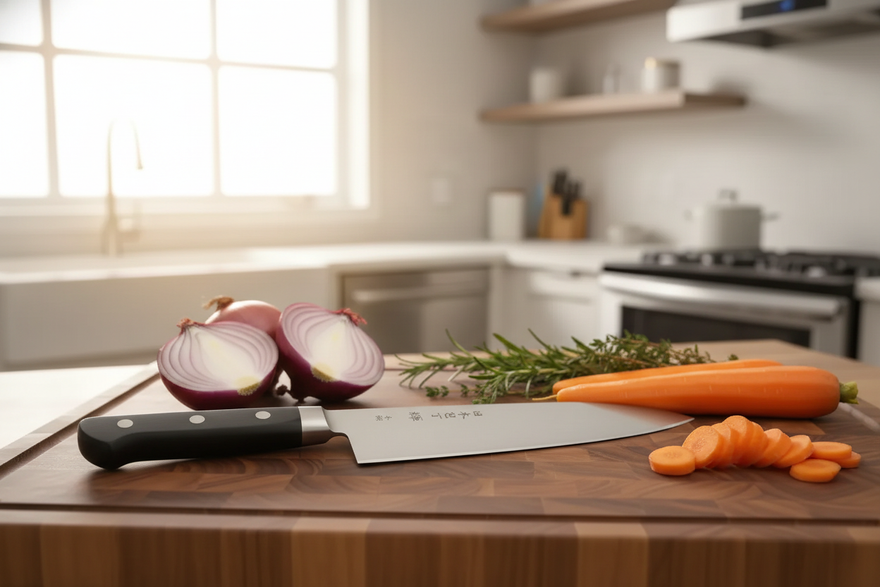
You buy a Gyuto because you want one knife that feels precise, agile, and capable across most of your daily prep. Then the first real question appears: how should you actually use it? Many cooks know that a Gyuto is often described as the Japanese answer to the chef's knife, yet that simple description misses what matters in practice. A Gyuto typically has a thinner blade, a more refined edge, and a profile that rewards clean technique. If you use it with the same force, board contact, and twisting habits you might use with a thicker knife, you may never experience what makes it special.
This article explains how to use gyuto knife styles correctly, from grip and hand position to push cutting, light rock chopping, and cutting board technique. If you are still learning the broader shape, purpose, and design logic of this knife style, our gyuto knife guide gives helpful background. At Japanese Chefs Knife, guidance is shaped by direct knowledge from Seki City and by Koki Iwahara's decades in the Japanese knife trade, so the goal here is simple: help you use a Gyuto with more control, less strain, and better respect for the blade.
What a Gyuto is meant to do
A Gyuto is a general-purpose Japanese chef's knife designed for slicing meat, trimming proteins, mincing herbs, and processing vegetables with speed and accuracy. In most kitchens, it becomes the knife you reach for first because it covers so many jobs well. The important point is not just versatility. It is the way a Gyuto tends to move through food.
Most Gyuto knives are ground thinner behind the edge than heavier all-purpose knives. In practice, this means the knife can pass through onions, carrots, cabbage, or boneless proteins with less wedging and less cracking force. That benefit depends on technique. A Gyuto usually responds best to smooth forward or downward-forward motion rather than hard vertical chopping.
Consider this: if you push a fine Gyuto straight down through a dense sweet potato with too much force, you ask the thin edge to behave like a cleaver. If you guide it with a controlled slicing or push cut, the blade geometry can work as intended. That difference is small in theory and very large on the board.
How a Gyuto differs from a European chef's knife in use
Many cooks come to a Gyuto after years of using a European chef's knife. The shapes look familiar enough that it is tempting to keep the same habits. The reality is that a Gyuto often changes what "normal" pressure and motion should feel like, especially because many Japanese blades are thinner behind the edge and can be hardened to higher levels than typical European kitchen knives.
Here's the thing: thinner geometry and harder steels usually reward a lighter touch. Instead of driving the knife with force, you guide it with clean, edge-leading travel. The cut becomes a controlled slice that happens to move downward, rather than a downward chop that happens to cut. This is also where twisting gets you into trouble. If you bury the edge in dense food and torque the blade to free it, you place lateral stress on a fine edge that is designed to be keen, not to be levered.
Profile and tip behavior can also feel different in use. Many Gyuto have a tip that feels more precise in detail work because it is relatively thin and can be steered with small wrist and finger adjustments. At the same time, the edge line on many Gyuto includes a flatter section that suits push cutting, especially on vegetables. A European chef's knife often has a more pronounced belly that makes continuous rocking feel natural. With a Gyuto, rocking can still be part of your toolkit, but the "default" motion often becomes forward travel with calm board contact.
For cooks transitioning from heavier European knives, the adjustment is mostly about what to unlearn. Avoid impact habits such as hard chopping landings, prying, and aggressive rocking that pins the tip into the board. What to adopt is simpler: keep your pressure modest, let the sharpness do the work, and keep the knife moving forward through the ingredient. From decades of handling and exporting Japanese blades, we have seen that most edge problems in home kitchens come less from the steel and more from technique that asks a Gyuto to behave like a thicker, softer knife.
How to hold a Gyuto knife

A pinch grip is a common and effective starting point
A pinch grip is one of the most practical ways to hold a Gyuto for many users. Place your thumb on one side of the blade, just in front of the handle, and your index finger on the other side. Your remaining three fingers wrap around the handle naturally. This grip moves control closer to the balance point, which usually gives you finer steering and a calmer wrist.
That said, grip style is personal. Hand size, cutting habits, and comfort all play a role. Some users, especially those transitioning from heavier European knives, find a handle grip more natural at first. In a handle grip, all fingers wrap around the handle without pinching the blade. It can feel more familiar and still gives good results when paired with clean cutting motion. The grip that gives you consistent control and a calm wrist is the right one for your hands.
Your guide hand matters just as much
Your non-knife hand should form a loose claw. Curl the fingertips inward and let the side of your knuckles guide the blade. This protects your fingertips and gives the knife a consistent reference line as it moves forward. If the guiding hand collapses or spreads flat, accuracy usually drops immediately.
Think of it this way: the knife hand drives the cut, but the guide hand sets the width, rhythm, and safety of every slice. Good gyuto knife grip technique is really a two-hand skill.
The main cuts you should learn first
Push cut
The push cut is often the most natural motion for using a Gyuto. Start with the heel or midsection of the edge contacting the ingredient, then move the knife slightly forward as it travels down. The forward motion helps the edge slice instead of crush. This is especially useful for onions, carrots, celery, cabbage, boneless meat, and herbs that bruise easily under blunt pressure.
From a practical standpoint, the push cut is the foundation of gyuto cutting technique because it matches the knife's refined edge geometry. If you learn only one movement first, make it this one.
Pull cut
A pull cut uses light rearward motion as the knife comes through the food. You may prefer it for tomatoes, cooked proteins, or ingredients with delicate skins. On a sharp Gyuto, the pull cut can feel very clean and quiet. It is less about force and more about letting the edge draw through the surface.
Light rock chop
Can you use a Gyuto for a rock chop? Yes, in many cases, but with restraint. A Gyuto can often handle a gentle rocking motion for herbs, garlic, and some vegetable prep, especially if the profile has enough belly. What many people overlook is that not every Gyuto is shaped for aggressive rocking. Some flatter profiles prefer more forward travel and less pivoting at the tip.
A light gyuto rock chop is usually fine. Repeated hard rocking with heavy tip pressure may place unnecessary stress on the edge and can dull it faster, especially on harder boards.
Vertical chop, used carefully
A straight up-and-down chop is not usually the best default for a Gyuto. It can work for soft items, but it often ignores the blade's slicing strengths. Reserve it for situations where ingredient size and texture truly call for it, and keep the motion controlled rather than forceful.
Using the right part of the edge
Tip: best for shallots, garlic, trimming, scoring, and detail work. Midsection: often the main working area for vegetables and proteins. Heel: useful for firmer items, larger ingredients, and the start of longer cuts.
Now, when it comes to ingredient size, match the edge length to the task. A 210mm Gyuto often gives enough length for home kitchens without feeling oversized. The JCK Original Kagayaki CarboNext KC-5 Gyuto 210mm fits this all-around role well. Its CarboNext high carbon tool steel (HRc 59–61) offers excellent sharpness and edge retention with better rust resistance than traditional carbon steel — a practical choice for cooks building a first serious Japanese knife setup or for professionals who want reliable daily performance. A longer profile can make full slices through cabbage or proteins easier, while a shorter one may feel more compact on crowded boards.
Gyuto length, height, and profile: choosing the right technique for your knife

Once you understand the basic cuts and which section of the edge does what, the next step is matching technique to the physical shape of your Gyuto. This is where many cooks improve quickly, because small changes in length, height, and profile can change both comfort and safety on the board.
Length changes your stroke and your working space. A 210mm Gyuto is often a comfortable starting point in a home kitchen because you can complete most slices in one smooth motion without feeling that the tip is constantly reaching past your cutting area. Longer knives can make large items easier because you have more edge to draw through the ingredient, but they also ask for more awareness on a crowded board. If your workspace is tight or you prep with other people nearby, a longer blade can feel less forgiving simply because there is more steel moving through the air.
Blade height affects knuckle clearance and guide-hand comfort. A taller Gyuto usually gives more space between your knuckles and the board, which can reduce strain during higher-volume prep. A shorter blade can feel nimble, but it may force you to adjust your posture or your guide-hand position to keep your knuckles clear. For most cooks, comfort is not a luxury. It is what keeps your technique consistent over a long prep session.
Profile maps directly to motion choice. A flatter edge line tends to support push cutting and controlled forward slicing, because more of the edge can stay close to the board without forcing a rocking arc. A profile with more belly tends to support a light rock chop, because the curve naturally rolls through herbs and small items. If you want to recognize this quickly, place the knife on the board and look at the edge line. If a long section sits close and flat to the surface, it will usually feel natural in push cuts. If the edge lifts quickly into a curve, rocking will feel more natural, but you still want to keep the motion gentle and avoid driving the tip hard into the board.
Board contact, speed, and control
Use the board as a stopping point, not an impact surface
Good gyuto cutting board technique depends on controlled contact. The edge should meet the board lightly, then stop. If you slam the blade into the board at the end of each cut, edge wear tends to increase and your rhythm becomes louder and less precise. This matters even more with harder steels and thinner grinds.
Your board choice plays a role here. A board that is too hard may accelerate dulling and increase the harshness of each landing. If you want a deeper look at suitable materials and setup, read our article on best cutting boards.
Build speed after the motion becomes clean
Many cooks try to become faster by moving their hands faster. In reality, speed usually comes from consistency. If your guide hand advances evenly and your knife path stays close to the board, speed will come naturally. Start slow enough that every cut lands where you intended.
Here is a practical sequence for training:
- Start with onions or cucumbers
- Use a pinch grip and claw hand
- Practice smooth push cuts in sets of ten
- Listen for soft board contact
- Increase pace only after slice thickness becomes consistent
Safe handling fundamentals: starting, stopping, and moving with a Gyuto
Using a Gyuto well is not only about the cut itself. Safety is often decided in the moments right before and right after the cut, when the knife is starting, stopping, or moving through the kitchen. A thinner, harder edge can be extremely effective in food, but it can also punish careless contact with hard surfaces.
Start and stop control is a real skill. If you need to pause, park the knife in a stable place where it cannot be bumped or grabbed carelessly. On the board, set the knife down deliberately. Avoid dropping the edge onto the board or letting the tip tap the surface, especially if your Gyuto is hardened and finely ground. The board should be a controlled stopping point during a cut, not a place where the blade lands casually when you are done.
Carrying and passing a Gyuto in a home kitchen should feel calm and intentional. Keep the tip oriented safely, keep the edge facing away from you and away from others, and avoid walking with the knife while distracted. If you hand the knife to someone, offer the handle first in a controlled way. Many kitchen accidents happen during movement, not during cutting.
What many people overlook is tip protection. Thin tips can be damaged by surprisingly small mistakes such as contacting a countertop, hitting a sink, or twisting while clearing food stuck to the blade. If you need to move ingredients off the blade, do it without torquing the edge. If the knife is in the sink, retrieve it carefully and do not let it knock against metal. Good technique respects the edge, but safe handling respects the whole knife, including the parts that are easiest to damage.
Common Gyuto mistakes
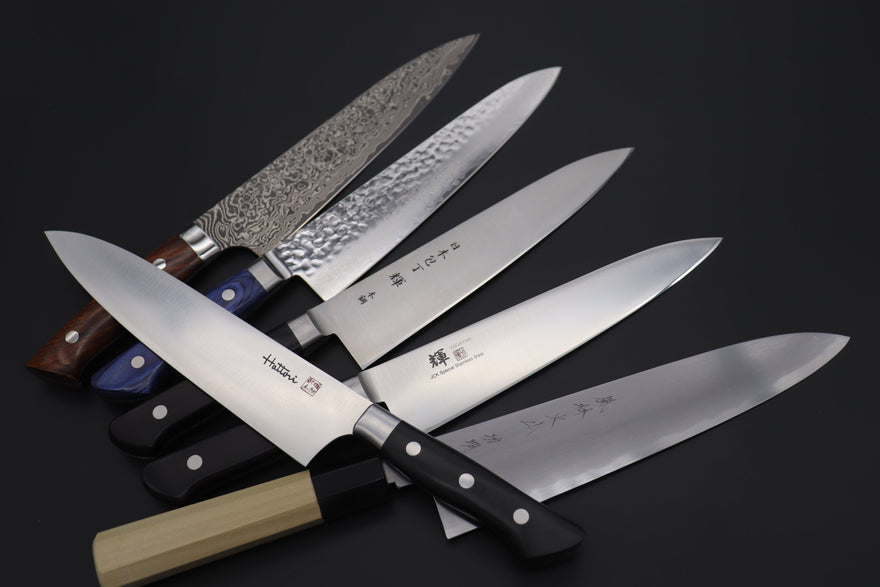
The most common problem is not lack of sharpness. It is using the knife with habits that do not suit its geometry.
- Twisting the edge inside dense food
- Scraping ingredients off the board with the edge instead of the spine
- Using excessive force on hard items or bones
- Trying to split frozen foods
- Over-rocking a flatter profile
- Allowing the wrist to collapse inward during long prep
Here's the thing: a Gyuto is a precision kitchen knife, not a heavy-duty impact tool. Even very capable steel cannot fully protect a fine edge from poor technique. If your cuts start to feel rough, the answer may be less force, a cleaner path, or a touch-up on the stones rather than simply pushing harder.
Maintenance is part of technique as well. A knife that has lost its edge encourages bad habits because you compensate with pressure. For that reason, it helps to understand sharpening gyuto properly before performance drops too far.
How steel and handle style affect technique
Carbon steel versus stainless steel

The JCK Original Kagayaki CarboNext KC-5 Gyuto 210mm ($140) is a strong example of what a well-designed carbon steel Gyuto can offer. CarboNext steel (HRc 59–61) delivers excellent sharpness and edge retention with improved rust resistance compared to traditional carbon steels — making it a practical entry point for cooks who want the feel of carbon steel without the demanding maintenance of older formulas. The black Pakka Wood handle and full tang construction keep the knife stable and comfortable through longer prep sessions.

At the other end of the handle spectrum, the JCK Original Kagayaki 悠久 (Yukyu) VG-10 Wa Series Premium Edition YUK-6 Wa Gyuto 210mm ($228) takes a different approach. Its semi-mirror-polished VG-10 blade (HRc 60–61) offers very good edge retention and high corrosion resistance in a stainless steel that is forgiving to maintain. The octagonal Ebony wood handle with Water Buffalo Horn ferrule shifts balance slightly forward and encourages a lighter, more precise grip. This knife also comes with a black lacquered wood Saya, which reflects the care that goes into the overall package. For cooks drawn to traditional Japanese aesthetics and a Wa-handle feel, the YUK-6 is a natural choice.
Wa-handle versus Yo-handle feel
A Wa-handle often shifts balance slightly forward and can make the blade feel nimble through ingredients. A Yo-handle, or Western-style handle, may feel more familiar if you are transitioning from a European chef's knife. Neither is automatically better. Your grip, hand size, and prep style usually decide the matter.
Japanese Chefs Knife is useful here because it is not a general kitchen retailer trying to flatten these differences into one sales message. From Seki City, and with Koki Iwahara's long export experience behind the catalog, the store presents real distinctions that serious buyers can use.
Technique should match the knife you actually own
If your Gyuto has a flatter profile, favor push cuts and controlled forward slicing. If it has a bit more belly, a gentle rocking motion may feel more natural. If the steel is very hard, reduce impact and avoid lateral stress. If the handle is lighter and more blade-forward, relax your grip and let the balance do some of the work.
That is the practical core of how to use gyuto knife styles well. You are not learning one rigid method. You are learning to read the knife, then match your motion to its design.
Frequently Asked Questions
Is a Gyuto better for push cutting or rock chopping?
In most cases, a Gyuto tends to excel at push cutting and slicing motions. Its thinner geometry and refined edge often reward forward travel through the ingredient rather than heavy vertical force. That said, some Gyuto profiles do support a light rock chop quite well, especially for herbs and smaller prep tasks. The key is restraint. A gentle rocking motion is usually appropriate, while aggressive rocking with hard board impact may dull the edge faster and can work against flatter profiles.
How should a beginner hold a Gyuto knife?
A beginner can start with either a pinch grip or a handle grip, depending on what feels natural. A pinch grip places the thumb and index finger on the blade just ahead of the handle, which generally improves control and keeps the knife more stable. A handle grip, where all fingers wrap around the handle, may feel more familiar if you are coming from a European knife. Either way, pair it with a claw grip on the guide hand so your knuckles, not your fingertips, lead the cut.
What do you use a gyuto knife for?
A Gyuto is a general-purpose knife used for most everyday prep: slicing and portioning boneless proteins, chopping and push cutting vegetables, mincing herbs, and doing light trimming work with the tip. In many kitchens it becomes the primary knife because it covers a wide range of tasks with good control. You should still avoid jobs that involve hard bone contact, frozen foods, or prying and twisting, because those actions can stress a finer edge.
Is a Gyuto good for beginners?
Yes, a Gyuto can be an excellent first serious Japanese knife, especially if you choose a steel and handle style that fit your maintenance comfort level. The key for beginners is learning a lighter touch and clean slicing motion, because a Gyuto often rewards technique more than force. If you are willing to practice controlled board contact and avoid twisting and impact habits, a Gyuto can be both approachable and very capable for everyday cooking.
How to hold a gyuto knife?
Start with the grip that feels most natural and gives you good control. A pinch grip — thumb and index finger on the blade just in front of the handle, remaining fingers wrapped around the handle — works well for many users and improves precision. A handle grip is also a valid choice, especially for those transitioning from heavier European knives. Keep your grip firm enough for control but relaxed enough that your wrist stays calm, and always pair it with a claw grip on the guide hand.
What is Anthony Bourdain's favorite knife?
People often ask this because Bourdain spoke openly about valuing simple, effective tools. Public interviews and quotes attributed to chefs can be inconsistent over time, and "favorite knife" can change depending on the kitchen and the work. From a practical standpoint, if you are trying to choose based on that idea, focus on the knife style and size that matches how you cook. A well-chosen Gyuto in a comfortable length, used with clean technique and kept sharp, is often more meaningful than copying any one person's preference.
Can I use a Gyuto for all kitchen tasks?
A Gyuto is designed as an all-purpose kitchen knife, so it can cover a very wide range of prep work. It is well suited to vegetables, boneless meat, herbs, and many everyday slicing tasks. Still, it is not meant for every job. You should avoid hard bones, frozen foods, and tasks that require twisting or prying. A Gyuto is a precision cutting tool. It performs best when you use it for clean slicing and controlled chopping, not impact-heavy or torque-heavy work.
What foods are best for practicing Gyuto knife skills?
Start with ingredients that reveal your technique without punishing small mistakes. Onions are excellent because they show whether your slices are even and whether the tip and mid-blade are moving smoothly. Cucumbers, zucchini, celery, and cabbage also work well. Once your push cut feels consistent, move to carrots and boneless proteins. Tomatoes are useful for testing edge sharpness and control. Very dense squash or bone-in proteins are not the best early practice materials for using a Gyuto well.
Do I need a special cutting board for a Gyuto?
You do not necessarily need a rare or highly specialized board, but board choice matters. A surface that is too hard can increase edge wear, especially on harder Japanese steels. Many cooks prefer wood or other edge-friendly materials because they soften board contact and can help preserve the knife's working edge. What matters most is that the board is stable, clean, and large enough for safe movement. The knife should contact the board lightly rather than striking it forcefully at the end of each cut.
Can I scrape food off the board with my Gyuto?
You should avoid scraping ingredients with the sharpened edge. That habit can roll or wear the edge prematurely, especially on thinner Japanese knives. If you need to move chopped ingredients, turn the knife over and use the spine, or use a bench scraper. Many users damage their edge gradually through board scraping rather than through actual cutting. It seems minor, but over time it can affect sharpness, edge life, and the feel of the knife in use.
How often should I sharpen a Gyuto?
There is no single schedule that fits every kitchen. Sharpening frequency depends on steel type, cutting board, how often you cook, and how refined you like the edge to feel. In a home kitchen, many users sharpen only when performance clearly drops. Others prefer light maintenance sooner to keep the knife in a more consistent state. Harder steels may hold an edge longer, but they still need care. If slicing becomes rough or tomatoes start resisting, it may be time to sharpen.
Is a 210mm Gyuto a good size for most people?
Yes, a 210mm Gyuto is often a very practical middle ground. It usually offers enough length for larger vegetables, proteins, and efficient slicing, while still feeling manageable for most home kitchens. For many users, it becomes the most versatile size because it balances reach with control. Board size and user comfort still matter. If your workspace is compact or you prefer a shorter knife, a smaller Gyuto may feel better. If you break down a lot of large produce, you may appreciate more length.
Does a Wa-handle change how a Gyuto should be used?
A Wa-handle can subtly change balance and feel, often making the blade seem more forward-weighted and nimble. The actual cutting motions remain largely the same, but your grip pressure may need to soften. Many users find that a Wa-handle encourages a lighter touch and smoother slicing rhythm. If you are coming from a heavier Yo-handle knife, the adjustment period may be brief but noticeable. Good technique matters more than handle style, though balance preferences can strongly affect comfort during longer prep sessions.
Is stainless steel easier for learning proper Gyuto technique?
For many cooks, yes. Stainless steel Gyuto knives, especially in well-known steels like VG-10, can be easier to live with while you are building habits around grip, board contact, and sharpening. They are generally less demanding about immediate drying than high-carbon steels. That convenience can help you focus on technique. High-carbon steels have their own strengths, particularly in sharpening feel, but they require more attentive drying and storage to prevent oxidation. That behavior is normal for the material, not a defect.
Key Takeaways
- A Gyuto usually performs best with smooth push cuts and slicing motions rather than forceful chopping.
- A pinch grip or handle grip, paired with a claw guide hand, improves control, consistency, and safety.
- Light board contact helps protect the edge and creates cleaner, quieter cutting rhythm.
- Different Gyuto steels and handle styles may change feel, balance, and how forgiving the knife is in use.
- Technique, sharpening, and proper board choice matter as much as the knife itself.
Conclusion
Learning how to use gyuto knife styles well is less about memorizing one formal method and more about understanding what the knife is asking from your hands. A Gyuto usually rewards precision, relaxed grip pressure, clean forward motion, and thoughtful board contact. If you adjust your cutting habits to match the blade's geometry, the knife can feel faster, calmer, and more exact in daily prep.
That is why serious cooks benefit from specialist guidance. Japanese Chefs Knife is rooted in Seki City, one of Japan's important knife-making regions, and the catalog reflects the perspective of Koki Iwahara's long experience in the field. If you are ready to explore authentic Japanese Gyuto knives, browse the selection at Japanese Chefs Knife and compare blade styles, steels, and handle types with your own cooking habits in mind. The best choice is rarely the most expensive one. It is the one whose design matches the way you actually work.
Knife performance varies based on individual use, cutting technique, and maintenance habits. The characteristics described in this article reflect general tendencies of Gyuto knives and the steel types mentioned, not guaranteed results for every user. High-carbon steel knives require regular drying, appropriate storage, and periodic sharpening. If they are not maintained properly, oxidation or edge degradation may occur, and this is a normal property of the material rather than a product defect. Japanese knives are precision tools, and some styles or very high-hardness steels may require greater skill and correct technique to use safely and effectively. Any pricing referenced here is subject to change, so please check the Japanese Chefs Knife website for current pricing and availability. Always handle sharp knives carefully and use safe cutting practices.


