


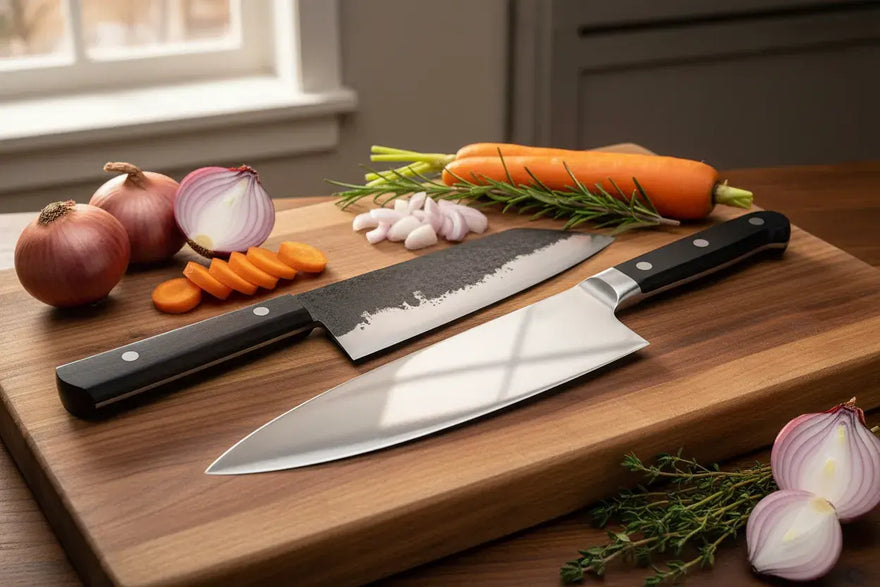
If you are deciding between a bunka and a gyuto, you are already looking at two of the most practical shapes in Japanese kitchen cutlery. Both are versatile, both can cover a wide range of prep tasks, and both appeal to cooks who want a knife that feels more precise than a heavier Western chef's knife. The difficulty is that they overlap just enough to create uncertainty. A bunka brings a compact, aggressive profile with a pointed reverse tanto tip, while a gyuto offers the familiar chef's knife silhouette with a longer edge and broader general-purpose range. At Japanese Chefs Knife, based in Seki City and guided by Koki Iwahara, the difference is best understood through blade geometry, steel choice, and how you actually cook. For broader context, see our all knife comparisons.
Quick Verdict
If you want a more familiar all-purpose chef's knife shape with easier maintenance, the gyuto is usually the safer starting point. If you prefer a flatter edge, a more compact profile, and a highly precise tip for vegetable work and detail cuts, the bunka can be deeply satisfying. In practical terms, a bunka often feels more specialized within general prep, while a gyuto usually feels more universally adaptable.
The two examples compared here make that contrast especially clear. The Fu-Rin-Ka-Zan White Steel No.1 Kurouchi Series FRBW1-7 Bunka 180mm (7 inch) at US$210 emphasizes traditional carbon steel sharpness and a distinctly Japanese cutting feel. The JCK Original Kagayaki Basic Series Gyuto (180mm to 270mm, 5 sizes, Black Pakka Wood Handle) at US$115 represents a stainless, beginner-friendly gyuto format that is easier to live with day to day.
Bunka and Gyuto at a Glance
The bunka and gyuto are both double-bevel (ryoba) knives in most modern interpretations, which means they suit right-handed and left-handed users more readily than traditional single-bevel forms such as yanagiba or deba. That shared geometry is one reason they are often compared. They can both slice proteins, mince herbs, prep vegetables, and handle most board work in a home or professional kitchen.
The bunka is typically shorter and flatter along the edge. Its defining visual cue is the angular k-tip, also called a reverse tanto tip. This shape gives excellent point control for scoring, trimming, and fine vegetable work. Many cooks choose a bunka because it feels nimble and deliberate on the board. If you want a fuller explanation of the pattern itself, our bunka knife guide is the natural next read.
The gyuto developed as Japan's response to the Western chef's knife, but in practice it has become its own category. A gyuto usually has more length options, a slightly more curved profile, and broader appeal as a true do-most-things knife. For readers weighing sizes and use cases, our gyuto knife guide covers that shape in more detail.
Neither is universally better. The right choice depends on whether you value compact precision or broad versatility, and whether you are comfortable with carbon steel maintenance or want the convenience of stainless steel.
Side-by-Side Comparison

| Knife | Price | Type | Steel | Best For |
|---|---|---|---|---|
| Fu-Rin-Ka-Zan White Steel No.1 Kurouchi Series FRBW1-7 Bunka 180mm (7 inch) | US$210 | Bunka | White Steel No.1 carbon steel | Cooks who want keen carbon steel performance and a compact all-rounder |
| JCK Original Kagayaki Basic Series Gyuto (180mm to 270mm, 5 sizes, Black Pakka Wood Handle) | US$115 | Gyuto | VG-1 stainless steel | Beginners and everyday users seeking easier upkeep and familiar versatility |
Bunka vs Gyuto vs Santoku: Where Each Fits
Here's the thing: many cooks talk about bunka, gyuto, and santoku as if they are interchangeable, because all three can handle daily prep. In real use, they overlap, but they do not feel the same on the board. If you understand what each shape is trying to do, the decision becomes much simpler.
A santoku is often the "middle ground" that confuses people. It is typically shorter than a full-size gyuto and more compact in height, but it usually has a friendlier tip than a k-tip bunka. The profile often sits between the flatter bunka feel and the more curved gyuto feel. For most home cooks, that middle positioning is exactly why santoku has become popular: it can feel controlled in a small kitchen while still behaving like a general-purpose knife.
From a practical standpoint, choose a bunka if you want maximum point control in a compact package. The flatter edge tends to reward push-cutting, tap-chopping, and deliberate board contact, especially on vegetables. It can be an excellent choice when your board space is limited, or when you do a lot of trimming and detail cuts and want the tip to behave like a precision tool rather than a rounded chef's knife tip.
Choose a gyuto if your ingredient size and prep volume regularly demand length. Longer slicing motions for proteins, portioning larger vegetables, and working through bigger piles of prep are where gyuto earns its reputation. The profile also tends to accommodate a wider range of cutting motions. If you sometimes push-cut, sometimes draw-slice, and sometimes use a light rock for herbs, a gyuto usually adapts without forcing you into one particular rhythm.
Choose a santoku if you want an all-purpose knife that emphasizes compact handling, typically without the sharper, more assertive tip behavior of a k-tip. It often suits cooks who want a Japanese-style, board-focused knife but do not need the longer reach of a gyuto or the aggressively pointed tip of a bunka. Think of it as a versatile home kitchen format that favors control and efficiency over maximum length.
The reality is that none of these is a universal winner. Your best choice comes down to how you cut, what you cook, and how much room you have. If you are deciding between bunka and gyuto, it helps to keep santoku in mind as the "in-between" option, not because you must buy it, but because it clarifies what you really want: more reach, more compact control, or a balanced compromise.
Fu-Rin-Ka-Zan White Steel No.1 Kurouchi Series FRBW1-7 Bunka 180mm
Fu-Rin-Ka-Zan White Steel No.1 Kurouchi Series FRBW1-7 Bunka 180mm (7 inch)
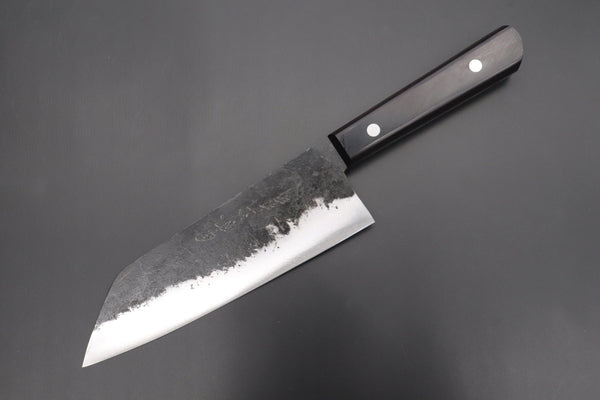
This bunka is a strong expression of what attracts cooks to traditional Japanese carbon steel. White steel No.1 (Shirogami No.1) is prized for its purity and sharpening response. In use, that usually means a very refined edge with excellent feedback on the stones. The kurouchi finish adds a rustic forged character that many enthusiasts appreciate, especially when they want a knife that feels closer to traditional workshop practice than to a highly polished production profile.
At 180mm, the length sits in a useful middle ground. It is long enough for most home prep and line tasks, yet compact enough to feel controlled on crowded boards. The k-tip profile makes this knife especially appealing for onion work, trimming, garlic prep, and precise cuts where point accuracy matters.
Taste in knife feel matters. This model is likely to appeal most to cooks who enjoy a flatter edge path and a more intentional push-cut or pull-cut style. It may feel less natural to those who rely heavily on rocking motions. Because it is carbon steel, it also asks more of the owner. You will need to wipe it dry, avoid prolonged moisture exposure, and accept that patina development is part of ownership.
Best use case: a cook who values sharpenability, crisp edge feel, and compact precision more than convenience.
JCK Original Kagayaki Basic Series Gyuto
JCK Original Kagayaki Basic Series Gyuto (180mm to 270mm, 5 sizes, Black Pakka Wood Handle)
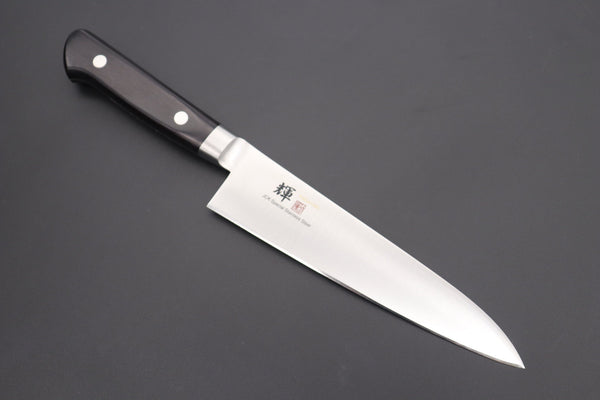
The JCK Original Kagayaki Basic Series gyuto highlights why the gyuto is often recommended as a first serious Japanese knife. Solid VG-1 stainless steel is much less demanding than reactive carbon steel, and that matters for everyday ownership. If you want a knife that can move from prep to service to cleanup without constant attention to moisture, stainless is often the more practical route.
The key advantage here is breadth of use. A gyuto profile typically accommodates more cutting styles than a bunka, especially for users who alternate between push cuts, draw cuts, and light rocking. The multiple size options in this series also make the format easier to match to your board space, ingredient volume, and comfort level.
The black pakka wood handle points toward a familiar, durable setup that many users find easy to transition into from Western knives. This is one reason the Kagayaki Basic series has long appealed to readers looking for a dependable entry into Japanese cutlery without moving immediately into reactive steel care routines.
Best use case: a cook who wants an accessible, stainless all-rounder with a classic gyuto range of motion and lower maintenance demands.
Key Differences
Blade profile is the first major difference. A bunka usually has a flatter edge and a more angular tip. That often favors straight, efficient board contact and detail work. A gyuto usually offers more belly and more length choices, which tends to make it more adaptable for mixed cutting motions.
Steel behavior is the second major difference in this comparison. The Fu-Rin-Ka-Zan bunka uses white steel No.1 carbon steel, which can take an exceptionally keen edge and is loved by many sharpeners. The tradeoff is reactivity. The Kagayaki Basic Series gyuto uses VG-1 stainless steel, which is easier to maintain but typically does not offer the same traditional carbon steel sharpening feel.
User profile is the third difference. A bunka often suits cooks who already know they prefer a flatter Japanese profile and are comfortable caring for carbon steel. A gyuto more often suits beginners, mixed households, and cooks who want one primary knife that asks fewer questions of them.
Value proposition also differs. At US$210, the bunka is less about entry price and more about blade character, steel purity, and a particular style of cutting experience. At US$109, the gyuto emphasizes accessible ownership and broad utility.
Tip Geometry and Control: K-Tip (Bunka) vs Gyuto Tip in Real Prep

What many people overlook is how much the tip changes the entire personality of the knife. A bunka's reverse tanto tip, the k-tip, is not just a visual style choice. It shifts where your control lives, and it changes which motions feel natural.
On a bunka, the k-tip tends to give you very direct point placement. That can be excellent for onion work when you want the tip to start a cut cleanly, for scoring eggplant skin or duck fat, for trimming silver skin, and for detailed vegetable cuts where you want to "draw" the tip through a line with confidence. For garlic, shallots, and smaller ingredients, that compact, precise feel is often the reason bunka owners stay loyal to the shape.
Consider this: the same angular tip that feels so accurate can be less forgiving if you are new to Japanese edges. The point is often thinner and more exposed than a rounder tip, and the geometry encourages detail work that sometimes tempts cooks to twist or pry. With harder Japanese steels and fine edge geometry, torque at the tip is one of the quickest paths to micro-chipping or a damaged point. The safest habit is to keep the cut moving forward or downward, and to avoid lateral pressure once the tip is engaged in the board.
A gyuto tip typically feels more familiar to cooks coming from Western chef's knives. It is well suited to piercing and opening cuts on proteins, starting longer draw slices, and transitioning from tip work into mid-blade slicing without changing posture. For many cooks, the gyuto tip also feels easier to manage in fast prep because it reads as "neutral," not as a dedicated detail point. That neutrality can be a real advantage if multiple people use the knife, or if your technique includes small rocking motions where the tip stays closer to the board.
Think of it this way: the bunka tip can reward careful hands with very high control, while the gyuto tip tends to offer a wider comfort zone across different tasks and experience levels. If you love precision and you are willing to protect the tip by cutting cleanly, a bunka can feel like a scalpel on the board. If you want a tip that behaves predictably across many classic chef motions, a gyuto is often the calmer choice.
Pros and Cons
Strengths
- Bunka knives offer excellent tip precision, especially for fine vegetable prep and detailed board work.
- Gyuto knives usually provide the broadest general-purpose range for most kitchens.
- White steel No.1 carbon steel is highly regarded for taking a very keen edge and sharpening cleanly on whetstones.
- VG-1 stainless steel is easier to maintain in busy daily use and better suited to cooks who want less reactivity.
- The 180mm bunka length feels compact and controlled without becoming too task-specific.
- The gyuto format offers more size flexibility, which can matter if you prep large proteins or large volumes of produce.
Considerations
- Carbon steel bunka ownership requires disciplined drying and storage to reduce rust risk and manage patina.
- A flatter bunka profile may not suit cooks who strongly prefer rocking cuts.
- Very acute Japanese edges can chip if used on bone, frozen food, or very hard surfaces.
- Stainless gyuto steel may be more forgiving in care, but some enthusiasts may find it less exciting to sharpen than traditional carbon steel.
Which One Should You Choose?
Choose a bunka if you want a knife that feels distinctly Japanese in profile and personality. It suits cooks who enjoy precise prep, flatter edge work, and the ritual of maintaining carbon steel. If your cooking leans heavily toward vegetables, herbs, small proteins, and controlled push cuts, the bunka can be deeply rewarding.
Choose a gyuto if you want the broadest margin of versatility. It usually makes more sense as a first Japanese knife, especially if you share your kitchen with others or want a more familiar adaptation from a Western chef's knife. For many households, the gyuto is the easier recommendation simply because it handles such a wide variety of prep with fewer maintenance demands.
If you are still undecided, ask yourself a practical question rather than a romantic one: do you want a knife that introduces you to traditional carbon steel character, or a knife that removes friction from daily use? That answer usually decides the matter.
How to Choose Between Them
1. Start with your cutting style. If you mostly push-cut and slice with a flatter edge path, a bunka may feel immediately natural. If you alternate techniques or use light rocking, a gyuto is usually more accommodating.
2. Be honest about maintenance. White steel (Shirogami) can reward careful owners with excellent sharpness and easy sharpening, but it is not forgiving of neglect. Stainless steel is usually the better fit for busy cooks, mixed kitchens, or anyone not yet ready for reactive steel habits.
3. Consider task range. A bunka is versatile, but its strengths are often most obvious in compact prep and fine control. A gyuto usually stretches more comfortably into larger ingredient prep, longer slicing motions, and true one-knife kitchen use.
4. Think about knife size and board space. The 180mm bunka compared here is compact and efficient. Gyuto lines with multiple sizes can be easier to tailor to your station. Smaller kitchens often favor shorter knives, while professional prep environments may benefit from more length.
5. Match the knife to your experience level. Beginners are often better served by a stainless gyuto because it lowers the learning curve. A carbon steel bunka is not only for experts, but it tends to suit buyers who already know they value steel feel, sharpening response, and a more specialized blade personality.
For readers ready to browse authentic Japanese knives more closely, Japanese Chefs Knife offers a specialist selection shaped by direct experience in Seki City, Gifu Prefecture. Koki Iwahara gives useful context. Whether you are leaning toward a traditional carbon steel bunka or a more approachable stainless gyuto, you can explore the range at japanesechefsknife.com and compare profiles, steels, and sizes with a clearer sense of what fits your kitchen.
Frequently Asked Questions
Is a bunka better than a gyuto?
Not universally. A bunka may feel better for cooks who prefer a flatter profile and precise tip work, while a gyuto is usually better for broader all-purpose use. The right choice depends on your cutting style, maintenance preferences, and whether you want compact control or maximum versatility.
Which is better for beginners, bunka or gyuto?
In most cases, a gyuto is the easier beginner choice. Its profile is more familiar, especially if you are coming from a Western chef's knife, and stainless versions are simpler to maintain. A bunka can still work for beginners, but carbon steel versions require more attention and a flatter cutting technique.
Can a bunka replace a gyuto?
For many home cooks, yes, a bunka can cover most daily prep. Still, a gyuto usually has the edge in overall range, especially for larger ingredients and longer slicing tasks. If you want one knife to handle the widest possible variety of jobs, the gyuto remains the safer generalist.
Is white steel No.1 better than VG-1 stainless?
They serve different priorities. White steel No.1 is often preferred for sharpness potential and sharpening feel, while VG-1 stainless is easier to care for and more forgiving in daily use. One is not simply better than the other. Your maintenance commitment and preferred knife behavior matter more.
Does bunka mean it is only for vegetables?
No. A bunka is often excellent with vegetables, but it is still an all-rounder. It can handle proteins, herbs, and general prep as long as you use it within normal knife boundaries. It is not intended for bones, frozen foods, or twisting through hard materials.
Which holds an edge longer?
Edge retention depends on steel, heat treatment, edge angle, board surface, and how the knife is used. Carbon steels and harder knives may hold a refined edge well, but they can also chip if misused. Stainless options may trade some sharpness feel for convenience and toughness in everyday use.
Are bunka knives good for left-handed users?
Most modern double-bevel bunka knives are suitable for both left-handed and right-handed users. The product data for the bunka and gyuto compared here indicates compatibility for both. That is different from many traditional single-bevel Japanese knives, which often require handed-specific versions.
Do I need special sharpening tools for these knives?
A whetstone is usually the best choice for Japanese knives because it preserves edge geometry more accurately than many pull-through devices. Carbon steel in particular responds very well to stone sharpening. Aggressive honing rods or unsuitable sharpeners can damage fine edges, especially on harder Japanese blades.
Which is better value?
Value depends on what you prioritize. The Kagayaki Basic Series Gyuto at US$109 offers broad versatility and easier care, which makes it strong practical value. The Fu-Rin-Ka-Zan bunka at US$210 offers a more traditional carbon steel experience and a distinct cutting feel, which may justify the higher price for the right user.
Should I get a bunka or gyuto?
If you want a single primary knife that covers the widest range of kitchen tasks with the most familiar handling, a gyuto is usually the safer choice. If you know you prefer a flatter edge, compact handling, and very precise tip control for vegetable work and detailed prep, a bunka can be an excellent fit. Your decision should reflect your cutting motion, your board space, and your willingness to maintain carbon steel if you choose a reactive blade.
What is a bunka knife good for?
A bunka is typically good for vegetable prep, onion work, trimming, scoring, and other tasks where tip accuracy and a flatter cutting path help. It also works well as a compact general-purpose knife for home kitchens, as long as you avoid bones, frozen foods, and twisting cuts that can stress a fine Japanese edge.
What chef knife does Gordon Ramsay recommend?
Individual chefs' recommendations can change depending on sponsorships, filming, and personal preference, so it is not reliable to buy purely based on a celebrity name. A better approach is to choose a knife profile that matches how you cook. If you want a versatile chef's knife style with familiar handling, a gyuto is the closest Japanese equivalent. If you want a compact knife with very precise tip control for detailed prep, a bunka may suit you better.
What are the three knives that everyone should have?
For most cooks, three knives cover nearly all kitchen work: a primary all-purpose knife (often a gyuto in Japanese cutlery), a small knife for in-hand and detail tasks (often a petty), and a knife that handles tougher jobs where you want more thickness and durability (many cooks use a heavier knife style for this role). The best mix depends on what you cook most often, but starting with a strong all-purpose knife usually makes the biggest difference.
Key Takeaways
- A gyuto is usually the easier all-purpose recommendation, especially for beginners.
- A bunka offers compact precision, a flatter profile, and strong appeal for detail-oriented prep.
- White steel No.1 carbon steel favors sharpness and sharpening feel, but requires careful maintenance.
- VG-1 stainless steel is easier to live with day to day and often suits busy kitchens better.
- The best choice comes down to cutting style, maintenance habits, and how specialized you want your all-rounder to feel.
Conclusion
The bunka versus gyuto question is really a question about how you cook. If you want a compact, distinctive knife with excellent point control and the character of traditional carbon steel, the Fu-Rin-Ka-Zan bunka makes a persuasive case. If you want a more familiar, stainless generalist with easier ownership and broad everyday reach, the Kagayaki Basic Series Gyuto is often the more practical answer. Neither choice is wrong. Each simply rewards a different style of use. If you are ready to compare authentic Japanese knives with guidance rooted in Seki City expertise, visit japanesechefsknife.com to explore the range and choose a knife that fits your kitchen, your technique, and your willingness to maintain it properly.
Knife performance can vary based on individual use, sharpening habits, cutting technique, board surface, and maintenance. High-carbon steel knives require specific care to reduce rust risk and patina development. Very hard or finely edged Japanese knives may chip if misused on bones, frozen foods, or hard surfaces. Always consider your cooking habits and maintenance commitment before purchasing, and handle sharp knives with appropriate care.


