


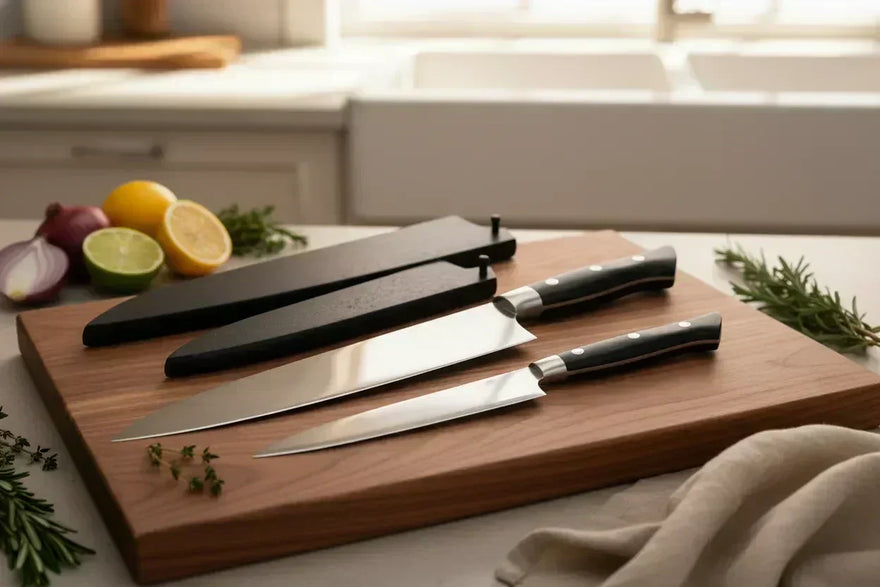
If you are looking for the best Japanese knife set, the most important thing to understand is that the right set is rarely about piece count. It is about whether the knives you get actually cover the tasks you do every day. A well-chosen two- or three-knife combination from a trusted Japanese maker will outperform a large block of mediocre blades in almost every kitchen situation. At Japanese Chefs Knife, based in Seki City, Gifu Prefecture, the selection reflects decades of experience in the Japanese knife export trade. That means every set recommended here is chosen for real cutting performance, honest steel quality, and long-term value rather than packaging appeal. If you want a broader look at best japanese knife sets, this guide will help you narrow the field by price.
What Makes a Good Japanese Knife Set
A strong Japanese knife set is defined by whether the included knives cover real kitchen tasks without overlapping too much. For most home cooks, the most efficient combination is a larger all-purpose knife paired with a smaller utility knife. In Japanese terms, that often means a gyuto or santoku paired with a petty. A three-piece set becomes compelling when the third knife adds a genuinely distinct function.
Steel matters as much as the lineup. At the entry level, VG-1 stainless steel offers a practical, forgiving, and rust-resistant option that is easy to resharpen. Moving up, you find carbon steel options like CarboNext and Swedish steel that reward attentive care with exceptional sharpness. At the mid-to-upper range, VG-10 Damascus has become one of the most sought-after choices in Japanese knives today — combining genuine cutting performance with a striking visual appeal that continues to grow in popularity. The JCK Natures Blue Clouds Series is one of the finest examples of this style available at this price point. For those seeking a step beyond, the Hattori Original VG-10 San-mai represents true premium craftsmanship — a knife set where every detail, from steel development to final finish, reflects the work of a master maker.
It is also worth remembering that the best Japanese knife set may actually be a curated two-piece combination rather than a factory-packed block set. If you are also comparing entry-level value, our look at best budget japanese knives can help clarify where steel and grind quality start to become meaningfully different.
How Japanese Sets Compare to Western-Style Block Sets
Here is the thing: Japanese-oriented sets tend to focus on fewer blades, with more attention placed on cutting feel and practical board work. Western block sets at similar prices often try to win on piece count, which usually means adding steak knives, a honing rod, kitchen shears, and several overlapping small knives.
Blade geometry is often the biggest difference you feel immediately. Many Japanese knives are ground thinner behind the edge and are designed to cut with less resistance through vegetables and boneless proteins. Thinner Japanese geometry can feel much more precise for prep, but it also rewards good technique and an appropriate cutting board.
Steel and hardness also tend to separate the two approaches. Japanese sets commonly use steels that are heat treated toward a harder feel than typical mass-market stainless. Harder steel can hold a refined edge longer in normal home use, but it means you should avoid twisting in hard ingredients and should not treat the knife as a tool for bones or frozen foods.
Quick Picks by Budget

- Around $290: Very Carbon Steel Lover 2Pcs Set — Kagayaki CarboNext Petty 125mm + Gyuto 240mm
- Around $240: JCK Natures Blue Clouds Series — VG-10 Damascus Petty 135mm + Santoku 170mm
- Around $290〜$348: JCK Special Set Type II — Kagayaki Basic VG-1 Petty + Santoku + Gyuto
- Around $323〜$364: Misono Carbon Steel Lover 2Pcs Set — Sweden Steel Paring 80mm + Gyuto 240mm
- Around $449: Master Ichiro Hattori Knife Set — NOAH Series Petty 150mm + Gyuto 210mm
Comparison Table
| Set | Steel | Key Knives | Best For | Price |
|---|---|---|---|---|
| CarboNext 2Pcs | CarboNext semi-stainless | Petty 125mm, Gyuto 240mm | Carbon steel lovers, high performance | $290 |
| Blue Clouds 2Pcs | VG-10 Damascus | Petty 135mm, Santoku 170mm | Beauty + performance, compact prep | $240 |
| Kagayaki Type II | VG-1 Stainless | Petty, Santoku, Gyuto | Best all-round starter set | $290〜$348 |
| Misono Sweden Steel | Swedish carbon steel | Paring 80mm, Gyuto 240mm | Misono brand, carbon steel feel | $323〜$364 |
| Hattori NOAH Set | Hattori Original VG-10 San-mai (3-layer) | Petty 150mm, Gyuto 210mm | Premium, collector-level quality | $449 |
Best Japanese Knife Set Options at Every Price Point
1. Around $290 — Very Carbon Steel Lover 2Pcs Set: Kagayaki CarboNext Petty 125mm + Gyuto 240mm

For cooks who want the feel of carbon steel without the full reactivity of traditional white or blue steel, the Very Carbon Steel Lover 2Pcs Knife Set JCK Original Kagayaki CarboNext Series KC-1ES Petty 125mm & KC-6ES Gyuto 240mm is an outstanding starting point. Both knives come with wooden saya and Tsubaki oil, making this a complete and thoughtful package.
CarboNext is a semi-stainless steel that sits between traditional carbon and full stainless. It offers a lively, responsive edge feel that carbon steel lovers appreciate, while being noticeably more forgiving about rust than white or blue steel. The 240mm gyuto covers primary prep work across proteins, vegetables, and herbs, while the 125mm petty handles trimming, garnish, and in-hand precision tasks.
- Semi-stainless CarboNext steel offers carbon-like sharpness with improved rust resistance
- Comes with wooden saya and Tsubaki oil — ready to use and store properly
- 240mm gyuto gives excellent reach for serious prep work
- Extra Sharpness (ES) finish for exceptional out-of-box performance
Considerations: Still requires more care than full stainless steel. Two knives only, so less broad than a three-piece set. 240mm gyuto may feel large in compact kitchens.
Who it suits: Home cooks and enthusiasts who want to experience the character of carbon steel without committing to the full maintenance demands of traditional carbon.
2. Around $240 — JCK Natures Blue Clouds Series: VG-10 Damascus Petty 135mm + Santoku 170mm
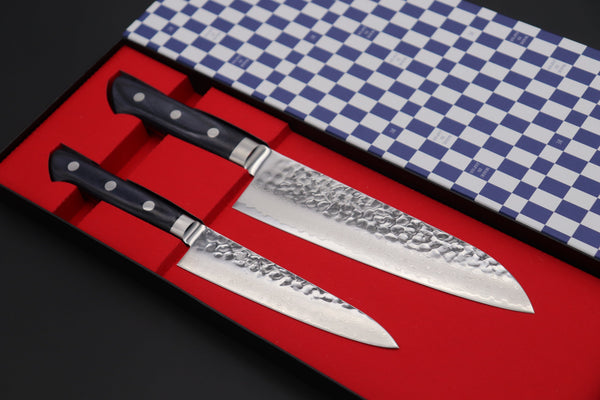
The JCK Natures Blue Clouds Series VG-10 Tsuchime Damascus Petty 135mm & Santoku 170mm 2Pcs Set brings together beauty and genuine cutting performance. The tsuchime (hammered) Damascus finish is not just visual — it also helps with food release during prep. Both knives use VG-10 stainless steel at the core, which offers strong edge retention and good rust resistance.
The 170mm santoku is an excellent compact all-rounder for vegetables, herbs, and smaller proteins. The 135mm petty sits in a very practical size range for detail work, trimming, and in-hand tasks. Together they make a focused, capable two-knife set that works well in smaller kitchens or as a gift for a serious home cook.
- VG-10 stainless core offers strong edge retention and easy maintenance
- Tsuchime Damascus finish aids food release and looks exceptional
- Compact santoku size suits smaller kitchens and boards
- Strong value for a Damascus VG-10 set at this price
Considerations: Santoku at 170mm may feel slightly short for cooks used to longer blades. Two knives only. Damascus finish requires gentle care to preserve appearance.
Who it suits: Cooks who want a beautiful, high-performing set that is also practical for everyday use, and anyone looking for a premium gift option.
3. Around $290〜$348 — JCK Special Set Type II: Kagayaki Basic VG-1 Petty + Santoku + Gyuto

For buyers who want the most complete practical lineup at this price point, the JCK Special Set "First Japanese Knife Set Type II" JCK Original Kagayaki Basic Series delivers three genuinely useful knives in one package. Using VG-1 stainless steel at HRC 60, this set offers a noticeable step up in edge feel and wear resistance over entry-level stainless options, while remaining practical and easy to maintain for busy home use.
The set includes a petty, santoku, and gyuto — covering fine detail work, compact vegetable prep, and primary board work respectively. This is the kind of set that makes sense for cooks who want to buy once and use it for years.
- Three genuinely useful knives with no filler pieces
- VG-1 at HRC 60 offers a refined edge feel and good retention
- Stainless steel is easy to live with in busy home kitchens
- Available in multiple size combinations to suit different preferences
Considerations: Having both santoku and gyuto may feel redundant in minimal kitchens. Not as wear-resistant as powdered or carbon steels. Some cooks may prefer a focused two-knife setup.
Who it suits: Anyone wanting a complete, ready-to-use Japanese knife set that handles daily cooking without demanding much in maintenance.
4. Around $323〜$364 — Misono Carbon Steel Lover 2Pcs Set: Sweden Steel Paring 80mm + Gyuto 240mm

The Misono "Carbon Steel Lover 2Pcs Set" Sweden Steel Series No.134 Paring 80mm & No.113 Gyuto 240mm brings together two of Misono's most trusted blades in a set that comes with magnolia wooden sayas and Tsubaki oil. Swedish steel is a high-purity carbon steel known for its clean sharpening response and the exceptionally keen edge it can achieve in skilled hands.
The 240mm gyuto is a serious primary knife with excellent reach for proteins, large vegetables, and general prep. The 80mm paring knife handles in-hand work, peeling, and fine detail tasks. This is a set for cooks who genuinely enjoy the sharpening process and want the character that carbon steel delivers.
- Swedish steel offers exceptional sharpening response and edge quality
- Comes with magnolia wooden sayas and Tsubaki oil
- Misono is one of Japan's most respected production knife makers
- 240mm gyuto gives serious reach for primary prep
Considerations: Carbon steel requires immediate drying and attentive care to prevent rust. Paring knife at 80mm is more specialized than a petty for board work. Higher maintenance commitment than stainless options.
Who it suits: Cooks who love carbon steel, enjoy sharpening, and want the Misono name behind their knives.
5. Around $449 — Master Ichiro Hattori Knife Set: NOAH Series Petty 150mm + Gyuto 210mm

The Master Ichiro Hattori Knife Set — Hattori Forums "NOAH" Series FHN-3L Petty 150mm & FHN-6L Gyuto 210mm represents the premium end of this guide. Both knives come with black lacquered sayas, and the set reflects the exceptional craftsmanship that has made Hattori one of the most respected names in Japanese knife making.
The NOAH Series uses Hattori Original VG-10 stainless steel in a three-layer (san-mai) construction, researched, developed, and refined in-house by Master Hattori. This approach balances durability, ease of sharpening, and practical everyday performance — a combination that reflects his philosophy of making knives that are both refined and genuinely usable. The 210mm gyuto is an ideal primary knife for most kitchens, and the 150mm petty is one of the most practical sizes for secondary work. Together they form a compact but deeply capable set.
- Hattori craftsmanship represents a genuine step up in fit, finish, and cutting feel
- Hattori Original VG-10 San-mai balances durability, sharpening ease, and performance
- Comes with black lacquered sayas — a complete, presentation-ready package
- 150mm petty is one of the most versatile secondary knife sizes
- A set that can last a lifetime with proper care
Considerations: Significant investment compared to other sets in this guide. Two knives only. Better suited to cooks who already understand proper Japanese knife technique and care.
Who it suits: Serious home cooks, professionals, collectors, and anyone ready to invest in a knife set they will use and appreciate for decades.
If you are comparing broader value tiers, our roundup of best affordable japanese knife sets may help you decide whether a bundled set or a custom pairing makes more sense.
How to Choose the Right Set
1. Prioritize coverage over quantity. The best Japanese knife set should cover core tasks, not every possible niche. A gyuto or santoku plus a petty already handles most household prep. A third knife only earns its place if it adds a genuinely useful difference.
2. Match steel to your maintenance habits. If you want simpler care, stainless options like VG-1 and VG-10 are safer choices. If you are comfortable drying immediately and managing patina, carbon options like CarboNext or Swedish steel can be very rewarding. Be honest with yourself about how much care you will realistically give your knives.
3. Think about board space and hand size. A 240mm gyuto is excellent if you prep in volume, but a santoku around 170mm to 180mm often feels more manageable in compact kitchens. A 150mm petty usually gives more versatility than a tiny paring knife if you want one small companion blade.
4. Watch edge geometry, not just steel names. A well-ground Kagayaki VG-1 knife can outperform a poorly chosen harder steel for many users. Look at whether the knife uses a practical double-bevel, whether it is meant for general prep, and whether the blade profile fits your habits.
5. Be honest about skill level. If this is your first serious Japanese knife purchase, a forgiving stainless set is often the wiser move. If you already sharpen on stones and cut with good technique, you can justify stepping into carbon or more specialized steels.
Common Mistakes to Avoid
The first mistake is treating piece count as value. Five or six extra knives do not help if they overlap in function. In practice, a large set at a given price often means the maker spread the steel and manufacturing cost across many pieces, leaving the main knife feeling less refined than a focused two- or three-knife combination.
The second mistake is overlooking maintenance realities. Carbon steel sets can feel very rewarding on the board, but if you are not prepared to wipe and dry immediately after use, a stainless set will serve you better in the long run.
The third mistake is assuming that "Japanese-style" automatically means Japanese-made. Authenticity matters because it is tied to heat treatment quality, grind consistency, and long-term support. When you buy from a specialist retailer that works directly with Japanese makers, you get clearer steel information and more consistent specifications.
Pros and Cons
Strengths
- Japanese knife sets in these price ranges deliver better steel and geometry than most large generic block sets.
- Two- and three-knife combinations cover real kitchen work more efficiently than oversized sets.
- Options range from easy-care stainless to premium carbon and collector-level craftsmanship.
- Well-chosen pairings let you spend on the knives that matter most.
Considerations
- Carbon steel combinations require more care and may not suit every buyer.
- Harder steels can be more prone to edge damage if used on bone, frozen foods, or poor cutting surfaces.
- The best value is not always a formal set, which means buyers may need to think carefully about their priorities.
Frequently Asked Questions
What is the best Japanese knife set for most home cooks?
For most households, the JCK Special Set Type II Kagayaki Basic is an excellent starting point. It covers core kitchen roles with VG-1 stainless steel that is easy to live with, and gives you a petty, santoku, and gyuto rather than a padded piece count. Its simple, classic design and genuine craftsmanship make it far more than a beginner's set — this is a practical, high-quality combination that can serve you faithfully for years, and for many cooks, it may well be the first and last knife set they ever need.
Is a two-knife combination better than a full knife block?
In many cases, yes. A gyuto or santoku plus a petty often handles nearly all common prep more effectively than a block filled with overlapping shapes. A smaller combination also lets you put more of your budget into blade quality and grind.
Should I choose stainless or carbon steel?
Choose stainless if you want lower maintenance and easier ownership. Choose carbon steel if you are comfortable drying immediately, preventing rust, and learning a more involved care routine. Carbon steel can feel very rewarding on the board, but stainless is usually the safer recommendation for first-time Japanese knife buyers.
What makes CarboNext different from traditional carbon steel?
CarboNext is a semi-stainless steel that offers the lively edge feel of carbon steel with improved rust resistance. It is not fully stainless, so it still requires more care than VG-1 or VG-10, but it is noticeably more forgiving than white or blue steel for everyday kitchen use.
Is JCK Natures Blue Clouds VG-10 Damascus Knives worth the extra cost?
VG-10 Damascus sets like the Blue Clouds offer genuine cutting performance alongside their visual appeal. The tsuchime finish also aids food release. If you value both aesthetics and performance, a Damascus VG-10 set can be excellent value at this price point.
What makes Hattori knives worth the premium?
The NOAH Series uses VG-10 stainless steel in a three-layer (san-mai) construction. What sets it apart is how Hattori uses that steel. Through decades of in-house research and refinement, Master Ichiro Hattori has developed his own manufacturing process specifically designed to draw the maximum performance from VG-10 San-Mai — in terms of edge quality, durability, and ease of sharpening. The result is a level of fit and finish that is difficult to find elsewhere. It is an investment in knives that can last a lifetime with proper care.
Do I need both a santoku and a gyuto?
Not necessarily. Many cooks work very comfortably with one or the other plus a petty. A santoku often feels better in smaller kitchens and for shorter, compact prep sessions. A gyuto usually offers more length and versatility for larger ingredients or more advanced board work.
What should I avoid in a Japanese knife set?
Avoid paying for inflated piece counts, unnecessary specialty shapes, and weak steel paired with attractive packaging. Focus instead on proven makers, sensible blade lineups, steel transparency, and whether the set supports real prep tasks in your kitchen.
Can these sets work for professional cooks?
Some can, especially the CarboNext, Misono Sweden Steel, and Hattori options. Professional cooks usually place more demand on edge retention and sharpening response, so a more performance-focused pairing tends to make more sense than a packaged beginner set.
Key Takeaways
- The best Japanese knife set is usually a practical two- or three-knife combination, not a large block.
- Kagayaki VG-1 stainless sets offer everyday cooks an approachable ownership experience with genuine Japanese cutting performance and quality.
- CarboNext and Swedish steel options reward attentive care with exceptional sharpness.
- Blue Clouds VG-10 Damascus sets combine genuine performance with outstanding visual appeal.
- Hattori Original VG-10 San-mai represents the premium end — a lifetime investment in craftsmanship.
- Choosing by use case, steel, and blade lineup will always lead to a better purchase than choosing by piece count alone.
Conclusion
The best Japanese knife set is not about finding the most pieces for the money. It is about building the most useful working combination for your kitchen. Whether you are drawn to the carbon-like character of CarboNext, the beauty and performance of VG-10 Damascus, the completeness of a three-knife Kagayaki VG-1 set, the tradition of Misono Swedish steel, or the lifetime craftsmanship of Hattori Original VG-10 San-mai, there is a set in this guide that fits your cooking style, your maintenance habits, and your budget. Japanese Chefs Knife, based in Seki City and shaped by decades of real knife-trade experience, is the right place to explore these options with confidence. Visit japanesechefsknife.com to compare authentic Japanese knife sets and find the combination that will serve your kitchen for years to come.
Knife performance can vary based on individual use, sharpening method, cutting surface, maintenance, and skill level. High-carbon steel knives require specific care to prevent rust and discoloration. Very hard steels can be more prone to chipping if misused on bone, frozen foods, or other unsuitable materials. Always handle sharp knives with appropriate care and choose a knife set that matches your cooking habits and maintenance commitment.


