


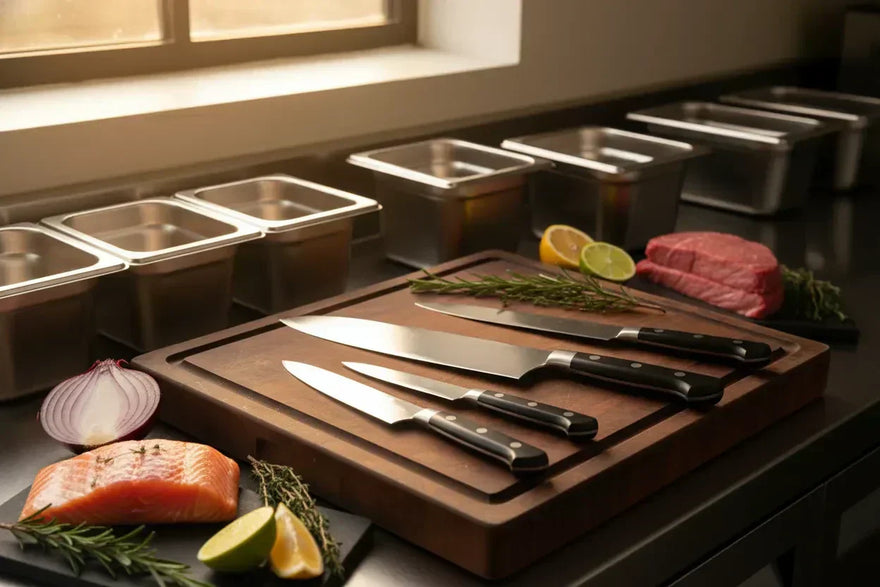
If you are trying to choose a line cook knife, the real question is not which knife looks most impressive on a roll. It is which knife keeps pace with prep, service, tight station space, and long hours on the board. In most professional kitchens, cooks do not rely on a huge collection during service. They usually lean on a compact, practical set built around a few dependable profiles. That is where Japanese knives stand out. Their thinner grinds, precise tip control, and steel options give line cooks serious performance, but they also demand a clear understanding of use and maintenance. If you want broader context on profiles and terminology first, this complete knife guide is a useful place to start. Below, we will look at what chefs actually carry, why they choose those knives, and which Japanese styles make the most sense on the line.
What a line cook knife really needs to do
A line cook’s knife is a working tool first. It has to move from prep to service without slowing you down. That usually means fast onion work, herbs, shallots, proteins, citrus, garnish, portioning, and the constant small corrections that happen during a shift.
In a restaurant, speed matters, but so does recovery. A knife that takes an excellent edge but chips under rushed, rough board contact can become a liability. A knife that is too large can feel awkward on a crowded station. A knife that is too specialized may perform beautifully at one task and sit idle the rest of the day.
That is why many professionals settle on a compact system rather than a single all-purpose miracle knife. The most common pattern is one primary chef knife, one petty or utility knife, and sometimes one dedicated slicer or station-specific blade depending on the menu.
From a Japanese knife perspective, the sweet spot for many line cooks is a double-bevel (ryoba) knife with manageable length, good edge stability, and steel that matches the user’s maintenance habits. In practical terms, that usually points toward a gyuto, santoku, petty, or sujihiki rather than a highly specialized single-bevel yanagiba or usuba.
What knives line cooks actually use
Ask enough professional cooks what knives they rely on and the answers tend to become more practical than romantic. Most line cooks use a short list of profiles repeatedly.
- Gyuto as the main prep knife. This is the Japanese chef’s knife equivalent and often the most versatile choice on a station.
- Santoku for cooks who prefer a shorter blade and a little more height in a tighter workspace.
- Petty for garnish, trimming, shallots, citrus, portion corrections, and in-hand precision work.
- Sujihiki where clean protein slicing matters, especially for cooked meats or fish portions.
What you usually do not see as a default line-cook choice is a full traditional sushi setup unless the station specifically calls for it. A single-bevel yanagiba, deba, or usuba can be brilliant in the right hands, but they are purpose-built tools with more specialized sharpening and handling demands.
A sushi chef knife set makes sense for sushi, kaiseki, or fish-focused traditional prep. For a general restaurant line, most cooks benefit more from a compact double-bevel kit that handles a wider range of tasks with less complication.
Utility and prep knives: when and why to consider them on the line
Here is the thing, many Western kitchens develop a quiet favorite that sits between a petty and a full chef knife. It is the utility or prep knife: long enough to do real board work, short enough to feel nimble when space is tight and hands are moving fast.
In Japanese terms, a petty can cover some of this territory, but many petty knives are optimized for in-hand work and lighter board contact. A compact gyuto or short santoku can also overlap, but some cooks prefer a middle length that feels less committed than a full-size main knife during service.
From a practical standpoint, a utility or prep knife tends to make sense when your station involves a lot of fast, repetitive tasks like portioning small proteins, slicing citrus, splitting buns, trimming, or doing quick pickup work where you want control more than reach. It can also be useful in crowded, mixed-cuisine kitchens where your board space changes shift to shift and you cannot always spread out for longer strokes.
The tradeoff is that this profile can become redundant if you already have a well-chosen gyuto and a petty and you actually use both. For most cooks, the classic two-knife pattern still wins on simplicity. If you find yourself reaching for your petty on the board too often, or grabbing your gyuto for tasks that feel cramped and awkward, that is usually the signal that a dedicated mid-size option could improve your workflow.
Best Japanese knife profiles for line cooks

Gyuto: the most common answer
If you want one knife to anchor a professional station, the gyuto is often the strongest answer. It has enough length for efficient board work, enough tip for detail, and enough profile versatility for vegetables, herbs, proteins, and general prep.
A 210mm gyuto is often the most balanced size for line cooks. It is long enough to work quickly but not so large that it becomes cumbersome in a busy, shared kitchen. A 240mm gyuto works well for cooks with more board space or heavier prep volume.
Santoku: compact and station-friendly
The santoku is especially practical when space is limited. Its shorter length and taller blade make it comfortable for rapid vegetable prep, herbs, and smaller proteins. Cooks moving fast in narrow prep areas often appreciate how controlled a santoku feels.
The tradeoff is reach. A santoku can feel slightly short if you routinely break down larger product or want longer slicing strokes.
Petty: the second knife you will actually use
A petty is not optional in most professional kits. It covers fine work that a gyuto or santoku can do, but less elegantly. Trimming silver skin, supreming citrus, cutting garnishes, opening packaging, and in-hand tasks are all easier with a petty.
For line work, 135mm to 150mm is usually the practical range. That gives you enough blade to be useful on the board without turning the knife into a mini gyuto.
Sujihiki: for clean slicing
If your station handles proteins that benefit from long, clean draw cuts, a sujihiki is worth carrying. It reduces sawing motion and helps preserve surface appearance on cooked meats and fish portions.
It is not always necessary for every line cook, but on grill, roast, or carving-heavy stations it can make a real difference. If you are building a more complete setup, a good slicer becomes more relevant, which is also where a best professional chef knife set framework can help you think through role-based additions.
How Japanese knife geometry and cutting technique can improve line efficiency
Consider this, the biggest day-to-day difference many cooks feel when switching to Japanese knives is not a logo or a finish. It is geometry. Many Japanese knives are ground thinner behind the edge and sharpened at a narrower edge angle than typical Western work knives. That thinness helps the blade move through onions, herbs, and dense vegetables with less resistance, and the tip shape on a gyuto tends to reward controlled, accurate detail work.
Where this matters most on the line is speed with consistency. A thinner grind can reduce wedging in tall product like onions or cabbage, and a more acute edge can make it easier to start cuts cleanly, which is a big part of why your brunoise looks tighter when you are moving fast. The tradeoff is durability. Thin, hard edges can chip if you twist the blade in product, scrape aggressively on the board, or hit hard inclusions.
Japanese knives also pair naturally with efficient cutting motions that many Western kitchens already use, but often without naming them. Push cutting, where the edge travels down and forward in one clean motion, tends to work very well with a gyuto. For garnish and vegetable prep, techniques like tanzaku-kiri (cutting into clean batons) and even katsuramuki (rotary peeling, commonly used for daikon) highlight what a fine edge and stable tip can do for control and presentation.
Think of it this way, you do not need to change your entire cooking style to benefit. Start by keeping the edge moving forward instead of rocking heavily, especially on a flatter Japanese profile. Use the full length of the edge instead of short chopping, and let the knife fall through the cut rather than forcing it. If you are transitioning from a heavier Western chef knife, keep your board technique calm and avoid torque. The line reward is real: less sticking, cleaner cuts, and a rhythm that stays efficient from prep into service.
Steel, handle, and durability considerations
Not every professional kitchen demands the same steel. The best choice depends on how disciplined you are about wiping the blade dry, how often you sharpen, and how rough service gets.
Stainless and semi-stainless options
For many line cooks, stainless is the safest starting point. Steels like VG-10, VG-1, AUS-8, Gingami No.3, and Sweden stainless options are easier to live with in wet, acidic, fast-moving kitchens. They still take a very good edge and reduce the stress of constant reactivity management.
Carbon and high-carbon options
White steel (Shirogami) and blue steel (Aogami) appeal to cooks who value sharpening feel and very crisp edge quality. They are excellent in skilled hands, but they ask more from the owner. Wipe them often, dry them immediately, and understand that patina and reactivity are part of the experience.
Blue Steel No.2 and Aogami Super may offer stronger wear resistance than White Steel No.2, while White Steel No.2 is often loved for its clean sharpening response. Neither is better in every case. It depends on whether you prioritize easier sharpening or longer working bite.
Powdered steels
R-2, SG-II, HAP-40, STRIX, and ZDP-189 sit in the high-performance tier. These steels can offer very strong edge retention, often at high hardness levels such as HRC 63, HRC 65, or even HRC 68 depending on the steel and heat treatment. That can be a major advantage on the line, but there is a tradeoff.
Very hard steels may be more prone to chipping if used carelessly, twisted through hard product, or slammed into unsuitable cutting surfaces. For cooks with disciplined technique, they can be excellent. For rougher kitchens, a slightly less hard stainless may be the more dependable choice.
Handle style
Western handles typically feel more familiar to many cooks trained in mixed kitchens. Wa handles are often lighter and shift balance forward, which many people prefer in Japanese knives. Neither is universally better.
What matters on the line is grip security, comfort over a long shift, and balance that suits your cutting style. If you transport your knives daily, protection matters too. A proper knife roll guide is worth reviewing if you are carrying multiple knives between home and work.
Japanese knife care and sharpening habits in high-volume kitchens

The reality is that most knife problems on the line come from small habits, not big mistakes. When service gets busy, a blade sits wet, gets wiped on an apron, gets tossed on a station, and the edge slowly degrades until it suddenly feels unusable. With Japanese knives, especially harder and thinner ones, the margin for neglect can be smaller.
For daily care, build a simple rhythm you can actually maintain. Wipe the blade frequently, especially after acidic ingredients. Keep the knife dry when it is not in your hand. If you are using carbon steel, that dry wipe matters even more, and leaving the blade wet on the board between tickets is one of the most common ways rust starts. Clean the knife promptly after service and avoid leaving it in a sink or soaking in dish water.
Now, when it comes to edge maintenance, many line cooks benefit from quick touch-ups rather than waiting for the knife to become fully dull. A few light strokes on a fine stone when you have a moment can bring back bite without turning into a full sharpening session. If you do not have time for stones during the week, scheduling a consistent sharpening day tends to work better than sharpening only when the knife fails you mid-shift.
What many people overlook is emergency behavior. When an edge feels tired, the worst response is usually to push harder, twist through product, or scrape aggressively to move cut ingredients. Those are common causes of micro-chipping and edge rolling, and they tend to show up fast on hard steels. If you need to move product, use the spine or a bench scraper. If you have to cut through something questionable, like a hard squash stem, packaging staples, or semi-frozen product, reach for a more appropriate tool rather than risking a thin Japanese edge.
Pros and Cons
Strengths
- Japanese double-bevel knives usually offer excellent cutting precision for line prep, especially in vegetables, herbs, and fine protein work.
- A gyuto and petty combination covers most real restaurant tasks without forcing you into an oversized knife set.
- There is a wide steel range, from easy-care stainless to high-performance powdered steels, so you can match the knife to your maintenance habits.
- Lighter wa-handle setups can reduce fatigue and improve agility during long prep sessions.
- Thin blade geometry often gives noticeably cleaner cuts than thicker, heavier kitchen knives.
- Specialized additions like sujihiki can improve presentation and slicing efficiency on protein-heavy stations.
Considerations
- Harder Japanese steels may chip if misused on bones, frozen foods, hotel pans, or poor cutting surfaces.
- High-carbon options require immediate drying and more attentive care to prevent rust or discoloration.
- Single-bevel knives are not the most practical default for general line work unless your station specifically demands them.
- A highly specialized or expensive knife may be less appropriate in rough, crowded kitchens where loss, damage, or misuse is more likely.
Who this approach suits
This approach suits cooks who want a professional kitchen knife setup that is realistic rather than performative. If you work garde manger, saute, grill, prep, or a mixed station, a practical Japanese lineup built around a gyuto or santoku plus a petty makes a great deal of sense.
It is also ideal for serious culinary students and ambitious home cooks who want to buy like a professional, but not overbuy. If your work is specifically sushi-focused, fish butchery-heavy, or rooted in traditional Japanese prep, you may need more specialized single-bevel tools. For everyone else, the best knife for a line cook is usually the one that handles most station tasks cleanly, sharpens predictably, and survives your actual workflow.
How to choose a line cook knife

Use these criteria before you buy.
1. Choose your main profile first
Start with the knife you will use most. For most cooks, that is a gyuto. If you prefer tighter control and shorter board space, santoku is a valid alternative. Do not start with specialty knives unless your station truly requires them.
2. Match steel to your kitchen reality
If your station is wet, acidic, and relentless, stainless is usually the smarter choice. If you love sharpening and can maintain carbon steel properly, White Steel No.2 or Blue Steel No.2 can be rewarding. If you want strong edge retention and have disciplined technique, R-2 or HAP-40 may be excellent fits.
3. Be honest about your sharpening habits
A knife is only as useful as the edge you maintain. Some cooks love stones and touch-ups. Others want longer intervals between sharpening. That answer should guide your steel choice more than brand prestige.
4. Think about size in station terms, not ego terms
A 210mm gyuto is often ideal because it fits most boards and tasks. A 240mm can be better for prep-heavy cooks. A huge knife may look impressive, but if it slows you down in service, it is the wrong tool.
5. Build a small system, not a fantasy set
A useful line cook knife set is often just two or three pieces. Start with a main knife, add a petty, then add a sujihiki or station-specific blade if your work justifies it. That is more practical than buying a large professional kitchen knife set you rarely use.
Recommended Japanese knives to consider

At Japanese Chefs Knife, the advantage is not just selection. It is the perspective behind the selection. The store operates from Seki City, Gifu Prefecture, and reflects the guidance of Koki Iwahara, whose decades in the Japanese knife export trade make a real difference when you are comparing steel, geometry, and use case rather than just looking at surface features.
For line-cook use, several verified options stand out depending on your priorities. The JCK Original Kagayaki CarboNext Series Gyuto (180mm, 210mm, 240mm, 270mm) is a strong fit for cooks who want a high-performance workhorse with improved rust resistance compared with traditional carbon steel. The JCK Original Kagayaki Basic Series Gyuto (180mm, 210mm, 240mm, 270mm) is a practical stainless choice with VG-1 steel at HRC 60. If you want a compact station knife, the JCK Original Kagayaki Basic Series KG-3 Santoku 180mm (7 inch) and the JCK Original Kagayaki Basic Series Petty (125mm and 150mm, 2 sizes) make a useful pairing. For cooks ready for a premium wa-gyuto, the JCK Original Kagayaki 悠久 (Yukyu) VG-10 Wa Series Premium Edition YUK-8 Kiritsuke Gyuto 210mm ($250) offers a solid VG-10 stainless blade with hand grinding and sharpening for ideal blade profile and cutting performance, an octagonal ebonywood handle with marble/white colored water buffalo horn ferrule, and saya included.
Frequently Asked Questions
What is the best knife for a line cook?
For most cooks, the best line cook knife is a 210mm gyuto. It is long enough for efficient prep, precise enough for detail work, and versatile across vegetables, herbs, and proteins. If your station is tight or your prep is lighter, a santoku can also work well. The better choice depends on your board space, cutting style, and how much reach you need during service.
Do professional chefs use santoku knives on the line?
Yes, some do, especially when they prefer a shorter, more compact blade. A santoku can be very effective for vegetable-heavy prep and smaller workstations. Its shorter profile may feel more controlled than a gyuto. The tradeoff is that it usually offers less slicing reach, so cooks handling larger prep volume often still prefer a gyuto as their main professional kitchen knife.
What knives do chefs use besides a chef knife?
Beyond a main chef knife, most cooks regularly carry a petty knife for trimming and garnish work. Some also add a sujihiki for cleaner slicing of proteins. In specialized kitchens, more dedicated tools come into play. In general line work, though, a practical setup is usually a gyuto or santoku plus a petty, with a slicer added only if the station really benefits from it.
What is the difference between a chef knife and a cook’s knife?
In most kitchens, the terms are used interchangeably. Both usually refer to the primary all-around knife on the station, the blade you rely on for most prep tasks. In Japanese knife terms, the closest match is typically a gyuto, which fills the same role as a Western chef knife or cook’s knife, with geometry and balance that may feel different in use.
What are the top-of-the-line chef knives?
Top-of-the-line chef knives are usually defined less by appearance and more by steel choice, heat treatment, grind quality, and how well the knife matches the user’s technique. High-end Japanese chef knives often use refined stainless steels, advanced powdered steels, or well-made carbon steel, paired with precise blade geometry. The best way to identify a truly high-level option is to focus on how you will use and maintain it, then choose a maker and steel that support that reality.
What not to cut with a chef knife?
A chef knife, especially a harder Japanese gyuto or santoku, should not be used on bones, frozen foods, very hard rinds, or tasks that involve twisting and prying. Avoid cutting directly on metal surfaces like hotel pans, and avoid scraping the edge aggressively on the board to move product. Those habits can quickly damage a fine edge and increase the chance of chipping.
How to chop food fast as a line cook?
Speed comes from repeatable mechanics and an edge that is truly sharp. Use a stable claw grip, keep your fingertips tucked, and aim for a smooth forward cutting motion rather than forcing straight down chops. Use the length of the edge, reset your product consistently, and keep your station organized so you are not wasting movement between cuts. A thin Japanese knife can help by reducing resistance, but the biggest gains usually come from calm technique and a maintained edge.
Is a line cook knife set the same as a sushi chef knife set?
No. A line cook knife set is usually broader and more general-purpose, built around double-bevel knives like gyuto, santoku, petty, and sometimes sujihiki. A sushi chef knife set often centers on single-bevel tools such as yanagiba and deba, which are more specialized. Unless you are doing dedicated sushi or traditional fish prep, a general line cook setup is usually the more practical choice.
Should a line cook choose stainless or carbon steel?
Most line cooks are better served by stainless or semi-stainless steel if the kitchen is fast, wet, and demanding. Carbon steel can offer excellent sharpening feel and edge character, but it needs immediate drying and more careful maintenance. If you already know you will keep up with wiping, oiling, and rust prevention, carbon can be excellent. Otherwise, stainless is usually the safer working choice.
Are very hard steels like HAP-40 or ZDP-189 good for line cooks?
They can be, especially for cooks who want strong edge retention and use disciplined technique. HAP-40 can reach around HRC 68, and ZDP-189 around HRC 65 in certain knives, which helps them hold an edge for a long time. The tradeoff is that harder steels may chip more easily if misused, especially on bones, frozen food, or poor cutting surfaces.
What size petty knife is best for a professional kitchen?
For most line cooks, 135mm to 150mm is the most practical petty size. It is long enough for board work and trimming, but compact enough for in-hand tasks and garnish work. Smaller paring knives still have a role, but a petty in this range is usually more useful across a full professional shift.
Do I need a knife roll as a line cook?
In most cases, yes. If you are carrying your own knives to and from work, a knife roll protects the edges, keeps your kit organized, and reduces the chance of accidental damage. It also matters for safety in transit. A proper roll becomes even more important once you move from one or two knives to a more complete station setup.
Can one knife handle a whole line station?
It can handle most tasks, but not all tasks equally well. A good gyuto can cover a large share of daily prep, especially in mixed kitchens. Still, a petty adds speed and control for detail work, and a sujihiki may improve protein slicing. The most efficient setup is usually one primary knife plus one small support knife rather than forcing one blade to do everything.
Which verified Japanese Chefs Knife models fit line-cook use best?
Strong verified examples include the JCK Original Kagayaki CarboNext Series Gyuto for a practical high-performance workhorse, the JCK Original Kagayaki Basic Series Gyuto for easy-care stainless use, and the JCK Original Kagayaki Basic Series Petty as a compact support knife. For cooks who prefer wa-style construction with a premium finish, the JCK Original Kagayaki 悠久 (Yukyu) VG-10 Wa Series Premium Edition YUK-8 Kiritsuke Gyuto 210mm is also worth serious consideration.
Key Takeaways
- A 210mm gyuto is often the most practical main line cook knife.
- Santoku works well in tighter stations or for cooks who prefer a shorter blade.
- A petty knife is one of the most useful secondary knives in a professional kitchen.
- Choose steel based on your maintenance habits, not just performance hype.
- For most cooks, a small, well-chosen kit is better than a large knife set.
Conclusion
A good line cook knife is not about tradition for its own sake, and it is not about chasing the hardest steel or the most dramatic finish. It is about fit. The right knife fits your station, your prep volume, your maintenance habits, and your technique. In many cases, that means a gyuto or santoku as your main blade, a petty for precision work, and a slicer only when the menu justifies it. Japanese Chefs Knife is especially useful here because the advice and selection come from a business rooted in Seki City and shaped by decades of real knife-trade experience. If you are ready to compare authentic options for professional kitchen use, visit japanesechefsknife.com and narrow your choice by profile, steel, and handle style rather than guesswork.
Knife performance can vary based on individual use, care, sharpening method, cutting surface, and skill level. High-carbon steel knives require specific maintenance to reduce the risk of rust or discoloration. Very hard steels may chip if misused on bones, frozen foods, or unsuitable surfaces. Always handle sharp knives with appropriate care and choose a knife that matches your cooking habits and maintenance commitment before purchasing.


