


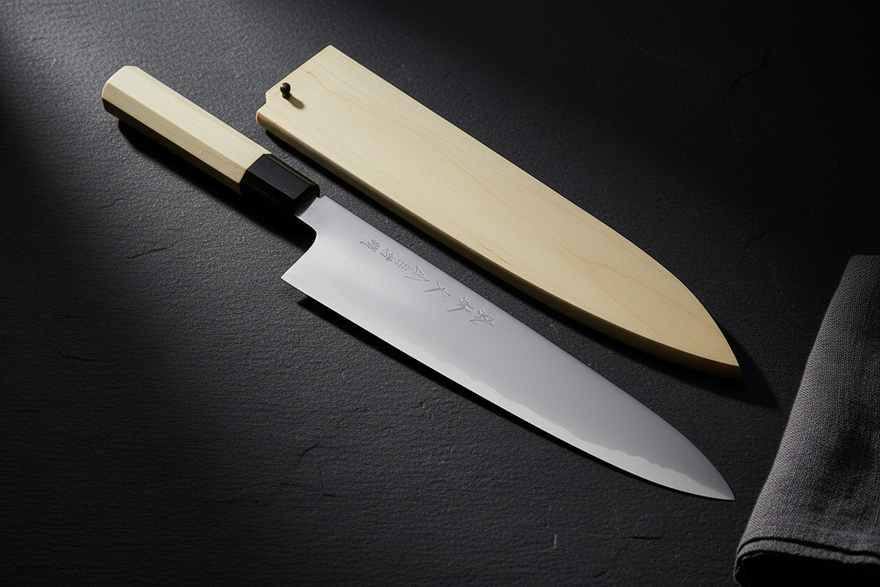
You start researching Japanese knives and quickly hit a wall of unfamiliar words. One page says Gyuto. Another says Santoku. Then you see Wa-handle, Kasumi, Shirogami, Honyaki, and single-bevel. If you want to choose well, that vocabulary matters.
These are not decorative labels. They explain blade purpose, steel behavior, construction method, sharpening demands, and the kitchen jobs each knife handles best. Learning Japanese knife terms can help you avoid choosing a knife that looks right but feels wrong in daily use.
At Japanese Chefs Knife, based in Seki City and led by Koki Iwahara, these terms are part of everyday trade knowledge, not vague marketing copy. What follows is a practical glossary for cooks and enthusiasts who want to understand what these words mean in the kitchen.
Why Japanese Knife Terms Matter
Japanese knife terminology usually tells you something specific about purpose, geometry, or craftsmanship. A Gyuto is not simply a chef's knife with a Japanese name. A Yanagiba is not just a long slicer. Each term carries design logic shaped by ingredients, technique, and sharpening tradition.
From a practical standpoint, knowing these Japanese knife terms helps you read product pages more accurately. You can spot whether a knife suits home prep, professional line work, vegetable cutting, fish fabrication, or fine slicing. You can also see why some knives ask more of you in maintenance and skill.
For broader cultural context, see japanese knife culture. If you are still building your foundation, a complete Japanese knife guide can be useful alongside a terminology article like this one. If your interest leans more toward traditional single-bevel patterns, a specialty knife guide can give valuable context.
Japanese Knife Terms for Blade Types
Gyuto, Santoku, Bunka, and Petty
Gyuto means the Japanese interpretation of a general-purpose chef's knife. It typically handles meat, fish, and vegetables with good versatility. If you see Wa Gyuto, that usually means a Gyuto fitted with a traditional Japanese handle.
A practical example is the JCK Original Kagayaki CarboNext Series Gyuto, offered in several lengths from 180mm to 270mm. It shows how makers offer the Gyuto format in different sizes for different prep volumes.
Cooks who want a more traditional carbon steel feel may also look at the Fu-Rin-Ka-Zan White Steel No.2 Wa Series Hon Kasumi Wa Gyuto (210mm to 270mm, 3 sizes). Here, the term Wa Gyuto signals both blade style and handle orientation.
Santoku often translates as "three virtues" or "three uses." The name usually points to meat, fish, and vegetables. Santoku knives tend to be compact, approachable, and practical for home kitchens with limited board space. The Hattori Forums FH Solid VG-10 Series FH-4L Santoku 170mm is a clear example of how Santoku design often appeals to users who want all-around performance in a slightly shorter format.
Bunka generally refers to a multipurpose knife with a more angular tip profile than a Santoku. Many cooks choose a Bunka for precise tip work on onions, herbs, and smaller proteins. The Fu-Rin-Ka-Zan White Steel No.1 Series FRKZW1-7 Bunka 180mm reflects that pattern well, especially for users drawn to carbon steel response and a more pointed front end.
Petty refers to a small utility knife. Think trimming fruit, shallots, herbs, and in-hand precision work. In many kitchens, a Petty complements a Gyuto rather than replacing it.
Nakiri, Deba, Yanagiba, Sujihiki, and Kiritsuke
Nakiri means a vegetable knife. It usually has a relatively straight edge profile that encourages clean, direct contact with the board. If your prep centers on greens, root vegetables, and fine julienne, Nakiri is one of the most useful Japanese knife terms to learn early.
Deba is a heavy, single-bevel fish butchery knife. Cooks use it to break down whole fish, separate heads, and work around fish bones and joints with controlled force. However, a Deba should not be treated like a Western cleaver or used to strike hard bone just because it looks thick.
Yanagiba is the long, single-bevel slicing knife associated with sashimi and sushi work. Its length and geometry support long drawing cuts that can help preserve surface quality on raw fish. The Fu-Rin-Ka-Zan Hon Kasumi Series Blue Steel No.2 Yanagiba (240mm to 300mm, 3 sizes) represents this classic format, where length, steel choice, and single-bevel geometry matter as much as brand name.
Sujihiki refers to a double-bevel slicer, often used for proteins and carving. Kiritsuke can describe a traditional hybrid profile, though product naming varies. In some lines it refers to a more specialized single-bevel knife. In others, it refers to a double-bevel profile inspired by that shape. This is one term where reading the full specifications matters.
More Japanese Knife Terms for Long Slicers
Once you start shopping for sushi and sashimi knives, you may also see related terms like Takohiki, Kiritsuke Yanagiba, or Sakimaru Takohiki. These names usually point to tip shape, regional tradition, and intended use. They do not always signal a completely different knife category.
Takohiki is a long slicer linked to certain regional styles and presentation work. Compared with a typical Yanagiba profile, Takohiki patterns often emphasize a straighter spine line and a more squared or chisel-like tip area in some versions. In practice, they still slice cleanly with controlled drawing motion.
Kiritsuke Yanagiba generally refers to a Yanagiba-style slicer with a more pronounced, sword-like pointed tip. Makers often use Kiritsuke Yanagiba to signal a tip shape that can help with detailed work, such as starting a cut cleanly on delicate fish, while preserving the long slicing behavior of the Yanagiba form.
Sakimaru Takohiki combines the idea of a Takohiki-style slicer with a Sakimaru tip. You can think of it as a more formal, presentation-oriented profile where tip shape and line quality matter. Even so, the technique expectation stays the same as with other long single-bevel slicers. You try to slice in one controlled pull rather than saw back and forth.
Length matters most here. Yanagiba-style knives are not long for decoration. A longer blade can make it easier to complete a slice in one drawing stroke, which may help texture and appearance when cutting raw fish. Shorter slicers can still work, but you may need a second motion more often, and that can show on the cut surface.
It also helps to read the label as a sharpening clue. A Yanagiba is typically single-bevel, which brings Ura, Uraoshi, and single-bevel angle management into the picture. A Sujihiki is typically double-bevel, which usually means more familiar sharpening and easier left-right symmetry for most users. Both can be excellent slicers, but these Japanese knife terms often imply different technique and maintenance expectations.
Japanese Knife Terms for Gyuto, Santoku, and Bunka

Now, when it comes to the first Japanese knife most people buy, the conversation often turns into a simple name comparison. Gyuto, Santoku, and Bunka are all commonly used as all-purpose knives, but the names do not tell the full story. They point to a typical profile, a typical length range, and a typical way the tip behaves on the board.
What the Names Usually Suggest
Think of it this way: Gyuto generally implies more length options and a profile that can cover larger prep volume comfortably. Santoku usually signals a shorter, more compact format that many home cooks find easy to manage. Bunka often signals a similar all-purpose intent, but with a more pointed, angular tip that supports fine tip work.
Common misconceptions show up here. Some buyers assume a Santoku is always safer or easier, but any knife depends on technique, sharpness, and attention. Others assume a Bunka is only for professionals, but in many home kitchens it is simply an all-around knife with a tip that feels more precise.
How to Choose Between Them in Practice
Another misconception is that Gyuto must be used with rocking. Many Gyuto profiles can rock to some degree. However, Japanese knives often reward controlled push cutting and slicing motions, especially on harder steels and thinner edges.
From a practical standpoint, use the name as a starting point, then match the profile to how you actually cook. If you like tip work, such as dicing onions cleanly, trimming, or making small precise cuts, Bunka or a Gyuto with an active tip can feel natural. If your cutting area is small and you want a compact knife that stays comfortable in tight board space, Santoku often fits that reality well.
If you do larger batches of prep, handle larger ingredients, or simply prefer a longer blade for smoother slicing, Gyuto tends to make more sense. What many people overlook is that your board, your motion, and your hand position matter more than the romance of the name. Ultimately, when you read product pages, pay attention to length, edge profile, and tip shape, then choose the term that matches those physical realities rather than relying on translation alone.
Blade Geometry and Japanese Knife Terms
Single-Bevel, Double-Bevel, Shinogi, and Hamaguri
Single-bevel means the knife is sharpened primarily on one side, as seen on many Yanagiba and Deba knives. This geometry supports highly specialized cutting behavior, but it also asks for correct technique and more informed sharpening.
Double-bevel means the knife is sharpened on both sides. Most modern Gyuto, Santoku, Bunka, and Petty knives are double-bevel, although some traditional or specialty Japanese models may use single-bevel geometry. For many users, double-bevel knives tend to be easier to adapt to in everyday cooking.
Shinogi is the ridge line separating blade surfaces on many traditional Japanese knives. On knives with pronounced geometry, the Shinogi helps define how the blade tapers and releases food.
Hamaguri refers to a clam-shaped convex grind. In practice, this convex shape can help the knife pass through food more smoothly, with less tendency to wedge or split the ingredient apart, though results vary by maker, steel, and sharpening state.
Sakimaru, K-Tip, and Edge Profile
Sakimaru describes a rounded, sword-like tip form seen on some traditional slicers. K-tip, often associated with Kiritsuke-inspired double-bevel knives and many Bunka profiles, describes an angular tip that can improve fine detail work.
Edge profile is not uniquely Japanese, but it matters when comparing Japanese knife shapes. A flatter edge line, as seen on many Nakiri and Santoku knives, often supports push cutting and clean chopping because more of the edge can contact the board at once. A more curved edge line, or more belly, as seen on many Gyuto and Western chef's knives, can make rocking motions easier. Many Japanese knives favor controlled push cuts, draw cuts, and precise board work rather than heavy rocking.
Japanese Knife Terms for Cutting Technique
Knife terminology is not only about the knife itself. Many Japanese knife terms start to make sense only when you connect them to the motion you use on the board. Two people can hold the same Gyuto and get very different results if one rocks aggressively and the other relies on controlled push cuts and draw slices.
Push Cut, Rocking, and Draw Cut
Push cut usually means you move the edge forward and down through food in a controlled motion, with the edge contacting the board cleanly. Knives with a flatter edge profile, such as many Santoku and Nakiri patterns, tend to reward this style because more of the edge can stay in contact with the board at once.
Rocking is the familiar Western chef's knife motion where the tip stays closer to the board while the heel lifts and falls. Some Gyuto profiles support rocking. However, many Japanese profiles do their best work with less rocking and more direct, efficient strokes. If you rock heavily on a very hard, thin edge, you are more likely to twist the edge on the board. As a result, small chips can appear in some steels and grinds.
Draw cut, or pull slice, refers to slicing by drawing the knife toward you and letting edge length do the work. This is the core motion that a Yanagiba is built around. The long single-bevel geometry is meant to travel through fish in one smooth drawing stroke, not a sawing motion. That one-stroke expectation is not only tradition. It is functional, too, because it can reduce surface tearing and keep slices cleaner in appearance.
How These Terms Help You Shop
Tip shape connects directly to technique vocabulary. A K-tip or a more aggressive Bunka tip can support detail work like starting a cut precisely, scoring, and fine brunoise starts. By comparison, a rounder tip and more continuous belly can feel more natural for cooks who rely on a rocking rhythm. Neither is automatically better. The knife simply rewards certain mechanics.
A practical translation for shopping is to match the words you see to the motion you naturally use. If you tend to push cut and keep the knife more level on the board, pay attention to edge profile language and flatter shapes. If you do long slices on proteins, look closely at slicer terms like Sujihiki and Yanagiba, and remember that Yanagiba implies single-bevel technique and sharpening.
If you want detail control, tip terms like K-tip and Bunka start to matter more than the marketing description.
Japanese Knife Terms for Steel and Materials

Shirogami, Aogami, VG-10, and CarboNext
Shirogami, also called White Steel, is a high-carbon steel known for purity and sharpening ease. Many experienced users appreciate the direct sharpening feedback it can provide. The trade-off is that it requires careful drying and storage because oxidation may occur if moisture is left on the blade.
The Fu-Rin-Ka-Zan White Steel No.1 Series FRKZW1-7 Bunka 180mm and the Fu-Rin-Ka-Zan White Steel No.2 Wa Series Hon Kasumi Wa Gyuto show how White Steel terminology often appears with numbered variants. White Steel No.1 typically contains a bit more carbon than White Steel No.2, which may influence hardness potential and sharpening feel, though performance also depends on heat treatment and grind.
Aogami, or Blue Steel, is another family of carbon steels that often includes alloying elements intended to support wear resistance and edge retention. The Fu-Rin-Ka-Zan Hon Kasumi Series Blue Steel No.2 Yanagiba is a useful example because Blue Steel terms often appear on knives built for users who value carbon steel character but want somewhat different behavior from White Steel.
VG-10 is a stainless steel commonly seen in Japanese kitchen knives. It tends to appeal to users who want easier day-to-day corrosion resistance. The Hattori Forums FH Solid VG-10 Series FH-4L Santoku 170mm is a straightforward illustration of that naming convention.
CarboNext is JCK's proprietary steel name used in the Kagayaki CarboNext Series. Many buyers notice it because it does not fit neatly into the simple "carbon steel" or "stainless steel" categories. It is often chosen by users who want some of the responsive cutting and sharpening feel associated with carbon steel, while still wanting easier day-to-day care than fully reactive carbon steel. For that reason, the steel name itself has become an important part of the identity of the JCK Original Kagayaki CarboNext Series.
Hagane, Jigane, Stainless, and Carbon Steel
Hagane generally means the hard core steel, especially in traditional laminated construction. Jigane refers to the softer supporting steel around it. In laminated blades, these layers work together. One contributes cutting performance, while the other helps with toughness and structure.
Carbon steel refers to non-stainless or less corrosion-resistant steels that can take a very keen edge and often sharpen readily. They require attention. Stainless steel resists oxidation better in normal kitchen use, though it still benefits from prompt cleaning and drying.
Japanese Knife Terms for Construction and Finish
Kasumi, Hon Kasumi, San Mai, and Honyaki
Kasumi refers to a misty finish often seen on traditional laminated blades, where the contrast between hard core steel and softer cladding becomes visible. Hon Kasumi usually indicates a more refined expression of that traditional finish and construction language, though exact usage can vary by maker.
The Fu-Rin-Ka-Zan White Steel No.2 Wa Series Hon Kasumi Wa Gyuto and the Fu-Rin-Ka-Zan Hon Kasumi Series Blue Steel No.2 Yanagiba are good examples of how Hon Kasumi appears in actual product naming. This is not merely decorative terminology. It points to a certain traditional approach to blade structure and finish.
San Mai means a three-layer construction, typically a hard center steel sandwiched between softer outer layers. Many Japanese knives use some form of laminated construction because it balances cutting performance with durability in practical use.
Honyaki refers to a mono-steel blade made through a demanding process more comparable to traditional sword-inspired hardening methods. Honyaki knives can be extraordinary tools in skilled hands, but they also tend to be costly and less forgiving if misused. The Mizuno Tanrenjo Akitada Honyaki Series White Steel Wa Gyuto, priced from $1,060.00 to $1,680.00, shows why the term Honyaki signals a very different level of craftsmanship and commitment from an entry point all-purpose knife.
Tsuchime, Damascus, Migaki, and Kurouchi
Tsuchime means a hammered finish. Damascus usually refers to layered pattern welding or decorative laminated patterning. Migaki indicates a polished finish, while Kurouchi refers to a dark forge scale finish left on parts of the blade. These terms can affect appearance and sometimes food release, but they should not be read as simple rankings of quality.
Handle and Profile Terminology

Wa, Yo, Octagonal, Oval, and Balance Point
Wa means a traditional Japanese handle, often lighter than a Western-style handle and commonly shaped octagonal, oval, or D-shaped. A Wa-handle often shifts balance slightly forward toward the blade, which many users find helpful for precise slicing and push cutting.
Yo refers to a Western-style handle. It is often heavier, more enclosed in feel, and familiar to cooks transitioning from European chef's knives.
What many people overlook is that handle terminology affects feel over a long prep session. If you spend an hour on onions, cabbage, herbs, and proteins, a lighter Wa-handle and a heavier Yo-handle can feel meaningfully different even when blade length is similar.
Heel, Spine, Choil, Ferrule, and Machi
Heel is the rear cutting section near the handle. Spine is the top, non-cutting edge of the blade. Choil is the area where blade meets handle. Ferrule is the front collar section on many Wa-handles, often made from horn or a contrasting material. Machi refers to the slight gap sometimes visible between blade and handle on traditional fitted knives. For enthusiasts, these details often reveal how a knife is finished and how traditional its construction approach may be.
Regional and Craft Words Worth Knowing
Seki, Sakai, Echizen, Sanjo, and Tosa
Seki, or Seki City in Gifu Prefecture, is one of Japan's major cutlery centers, known for blending deep knife-making history with modern production capability. For Japanese Chefs Knife, this matters because the business operates from Seki City and draws on decades of direct experience in the Japanese knife export trade.
Sakai is strongly associated with traditional single-bevel craftsmanship and specialist sharpening.
Echizen is known for blacksmithing tradition and a wide range of handcrafted kitchen knives.
Sanjo, located in Niigata Prefecture, has a long history as a center of Echigo Uchi-hamono, the forged blades of the Echigo region. Across generations, Sanjo has produced some of Japan's respected blacksmiths, and the area remains one of Japan's important regions for high-quality traditional forged knives.
Tosa has its own rustic and work-oriented blade tradition. These regional names are not interchangeable. They often suggest different histories, finishing styles, and production methods.
Hocho, Togishi, Kajiya, and Uraoshi
Hocho simply means kitchen knife. Kajiya means blacksmith. Togishi refers to a sharpener or polisher, an especially important role in traditions where forging and sharpening may be handled by different specialists.
Ura refers to the slightly hollow-ground back side found on many traditional single-bevel knives. Uraoshi is the sharpening process used to maintain the flat contact area on that back side. If you own a Yanagiba or Deba, these terms are not just specialist vocabulary. They describe an important part of proper single-bevel knife care.
If you are ready to move from terminology into actual knife selection, browse the Japanese Chefs Knife catalog by blade style and construction method. Because Japanese Chefs Knife focuses on authentic Japanese cutlery, its product pages can also serve as a practical reference for seeing these terms used in context.
Frequently Asked Questions
What does Gyuto mean in Japanese knife terminology?
Gyuto is generally understood as the Japanese chef's knife. It is one of the most versatile blade types in modern Japanese kitchens and tends to suit cooks who want one knife for proteins, vegetables, and most daily prep. In actual buying terms, Gyuto does not describe just one feel. Length, steel, grind, and handle style can change the experience significantly. A Wa Gyuto, for example, may feel more blade-forward and traditional than a Yo-handled version.
What is the difference between Santoku meaning and Bunka meaning?
Santoku usually refers to a compact all-purpose knife associated with three primary kitchen tasks, often meat, fish, and vegetables. Bunka is also multipurpose, but it usually carries a more pointed, angular tip. In practice, that tip can make Bunka especially useful for detail work, fine mincing, and precise cuts around smaller ingredients. Santoku often feels a bit more relaxed and approachable, while Bunka may appeal to cooks who want versatility with a more aggressive front end.
What does Nakiri mean, and who should use one?
Nakiri means a vegetable knife. Its flat edge profile and rectangular shape are designed for efficient board contact during vegetable prep. If your cooking involves frequent slicing of cabbage, carrots, onions, greens, or daikon, a Nakiri can feel very natural. It is less suited to tasks requiring a pointed tip, such as trimming silver skin or making intricate shallow cuts. For many home cooks, Nakiri becomes a favorite secondary knife rather than the only knife in the kitchen.
What does Yanagiba mean, and is it only for sushi chefs?
Yanagiba refers to a long, narrow single-bevel slicing knife traditionally used for sashimi and sushi preparation. It is designed to make clean drawing cuts through fish with minimal surface disruption. While it is strongly associated with professional sushi work, serious enthusiasts also use it at home for fine slicing tasks. That said, it is a specialized tool. If you do not prepare raw fish or delicate sliced proteins regularly, a Yanagiba may be less practical than a Gyuto or Sujihiki.
What does Deba mean in knife terminology Japan uses?
Deba is a traditional, thick, single-bevel knife used mainly for fish fabrication. It is built for separating heads, opening fish, and working around fish bones and joints with measured control. People sometimes mistake it for a heavy cleaving knife, but that can be misleading. A Deba is strong, yet still a precision Japanese knife with geometry that deserves proper technique.
What does Wa mean on a Japanese knife?
Wa means a traditional Japanese-style handle. Compared with many Western-style handles, a Wa-handle is often lighter and can shift the knife's balance point forward. That can change how the knife feels during long prep sessions, especially in push cutting and slicing. Wa-handles also come in different shapes, such as octagonal or oval. The term does not automatically mean better. It means different, and whether it suits you depends on grip preference, cutting style, and the kind of balance you find comfortable.
Are Japanese knife terms for steel like Shirogami and Aogami more important than knife shape?
Both matter, but knife shape usually determines task suitability first. Steel choice then affects sharpening behavior, edge retention tendencies, and maintenance demands. Shirogami and Aogami are meaningful Japanese knife terms because they tell you something about material family and expected care, especially around oxidation and sharpening feel. Still, a perfectly chosen steel in the wrong knife type will not solve a mismatch in cutting task. For most buyers, start with blade type, then refine the decision by steel, construction, and handle style.
What does Honyaki mean, and is it suitable for beginners?
Honyaki refers to a traditionally hardened mono-steel construction that is technically demanding to make and often expensive to buy. These knives can be remarkable, but they are not usually the first recommendation for a beginner. They may require more informed handling, sharpening confidence, and a clear understanding of what you want from a knife. For many cooks, a well-made laminated knife offers a more practical starting point.
Why do so many Japanese knife product names include terms like Kasumi or Hon Kasumi?
Those terms often point to blade construction and finish tradition rather than simply appearance. Kasumi is associated with a misty visual contrast and laminated structure, usually with a harder core steel supported by softer material. Hon Kasumi often suggests a more refined traditional expression, though exact usage can vary by maker. Reading those terms carefully helps you understand whether a knife is likely to reflect a classic construction approach.
How can I use a Japanese knife glossary when shopping online?
Use terminology as a filter for what matters most to your cooking. Start with blade type, such as Gyuto, Santoku, Nakiri, or Yanagiba. Then look at steel terms, such as VG-10, White Steel, or Blue Steel, to understand maintenance and sharpening expectations. After that, check construction words like San Mai, Kasumi, or Honyaki, and finish with handle terms such as Wa or Yo. If you still feel uncertain, Japanese Chefs Knife is one specialist resource where you can compare authentic Japanese knife categories with guidance grounded in Seki City Japanese knife trade experience.
What is a Gyuto knife used for?
A Gyuto is used as an all-purpose kitchen knife for most daily prep, including slicing proteins, chopping vegetables, and general board work. In most kitchens it becomes the primary knife because it covers a wide range of tasks without being overly specialized. Gyuto knives are also offered in multiple lengths, so you can match the knife to your board space and prep volume.
What are the key differences between a Gyuto and a Western chef's knife?
The terms overlap in function, but there are common differences in feel and geometry. Many Gyuto patterns emphasize thinner cutting geometry and a profile that rewards controlled push cutting and slicing rather than constant rocking. Handle style can differ as well, especially when a Gyuto is fitted with a Wa-handle, which often shifts balance forward.
How do you sharpen a Gyuto compared with other Japanese knives?
A Gyuto is usually double-bevel, so sharpening is usually a left-right process similar in concept to other double-bevel knives, such as Santoku or Bunka. Compared with many European knives, Japanese double-bevel knives are often sharpened to a more acute edge, which can feel very precise but also benefits from careful technique. Single-bevel knives like Yanagiba and Deba are different. They involve maintaining the front bevel geometry and managing the Ura and Uraoshi on the back side.
What length Yanagiba should I choose for sashimi slicing?
Yanagiba length is closely tied to technique. A longer blade can make it easier to slice in one smooth drawing stroke, which is part of why Yanagiba exists as a category. If you frequently slice wider fillets or want more margin to complete a single stroke cleanly, longer lengths are often preferred. If you are working in a small home kitchen or preparing smaller portions, a shorter Yanagiba can still be practical, but you may need to be more careful about maintaining that one-stroke slicing motion.
Key Takeaways
- Japanese knife terms usually describe real differences in function, steel, geometry, or construction, not decorative branding.
- Blade type comes first: Gyuto, Santoku, Nakiri, Deba, and Yanagiba each suit different kitchen tasks.
- Steel terms such as Shirogami, Aogami, and VG-10 help you understand sharpening feel, edge behavior, and maintenance needs.
- Construction terms such as Kasumi, San Mai, and Honyaki describe how a blade is made. They can also give buyers a clue about how much care, sharpening knowledge, or handling skill the knife may require.
- Handle terms such as Wa and Yo are important because they affect how a knife feels in the hand. A lighter Wa-handle and a heavier Western-style Yo-handle can create different balance, grip feel, and fatigue levels during long prep sessions.
Conclusion
The language of Japanese knives can seem dense at first, but it becomes practical very quickly once you connect each term to a real task, a real edge feel, or a real maintenance habit. Gyuto, Santoku, Nakiri, Deba, Yanagiba, Wa, Kasumi, Honyaki, Shirogami, and Aogami are not just collector vocabulary. They help you understand what a knife is built to do, how it may behave on the board, and what kind of care it will ask of you over time.
That matters whether you are buying your first serious Japanese knife or refining a working kit you already use every day. If you want to keep learning, explore the knife culture and knife type resources at Japanese Chefs Knife, or browse the store's selection by blade style, steel family, and construction. If you are unsure which Japanese knife terms match your cooking, Japanese Chefs Knife draws on direct, long-term experience in the Japanese knife trade to help you make a more informed choice.
Knife performance varies based on individual use, cutting technique, and maintenance habits. High-carbon steel knives require proper drying, storage, and sharpening. Japanese knives are precision tools, and some styles, especially single-bevel knives and knives with very high hardness ratings, require experience and correct technique to use safely and effectively. Pricing may change, so please check the Japanese Chefs Knife website for current details.


